Mimas
Mimas (Saturn I) is a moon of Saturn, discovered by William Herschel in 1789. It orbits Saturn every 23 hours and shines at about magnitude 12.9.
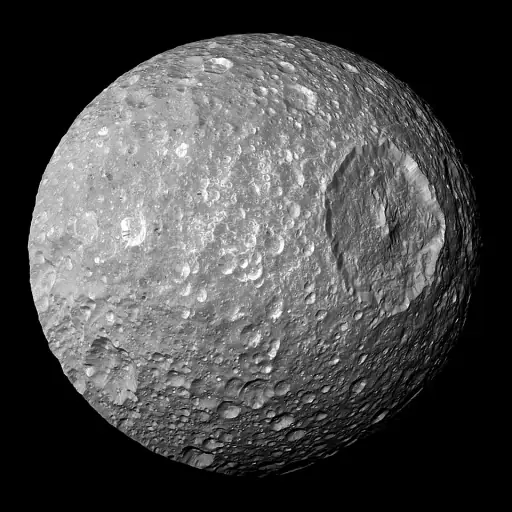
A small ice moon with one enormous crater — and an uncanny likeness to the Death Star.
One giant crater dominates Mimas. Named Herschel after the moon’s discoverer, it spans almost a third of the moon’s width, with walls about 5 km high and a central peak rising 6 km from the floor. On Earth, a crater on the same scale would be wider than Australia. The blow that made it must have nearly shattered Mimas: the ground on the far side is broken up, as if the shock wave rang through the whole moon.
Mimas is the smallest body known to have been pulled into a round shape by its own gravity, and it is made mostly of water ice. Careful tracking of how it moves has revealed a surprise: a young ocean of liquid water beneath its cratered crust, formed within the last 25 million years and perhaps only a few million years ago.
Small as it is, Mimas shapes Saturn’s rings. Its repeated pulls sweep particles out of the Cassini Division, the dark gap between the two broadest rings.
Did you know?
- A Death Star in orbit. With Herschel crater on its face, Mimas looks very like the Death Star of Star Wars — yet the film came out in 1977, three years before Voyager 1 photographed the moon.
- A Pac-Man made of heat. When Cassini mapped Mimas’s daytime temperatures in 2010, the warm and cool regions formed a shape just like Pac-Man.
- Smaller than Spain. The whole surface of Mimas is slightly smaller than the land area of Spain or California.
How big is it?
Our Moon could hold 674 moons this size. Mimas is 396 km across — 11% of our Moon’s width. It has about 1/1,960 of our Moon’s mass. A 70 kg person would feel like 0.5 kg on its surface.
A small moon with one giant crater. It hugs the edge of the rings — a real test of optics and seeing.
Other moons of Saturn: Enceladus, Tethys, Dione, Rhea, Titan, Hyperion, Iapetus.
Open AstroPilot to see where Mimas is next to Saturn tonight and how easy it is with your telescope.