Enceladus
Enceladus (Saturn II) is a moon of Saturn, discovered by William Herschel in 1789. It orbits Saturn every 33 hours and shines at about magnitude 11.7.
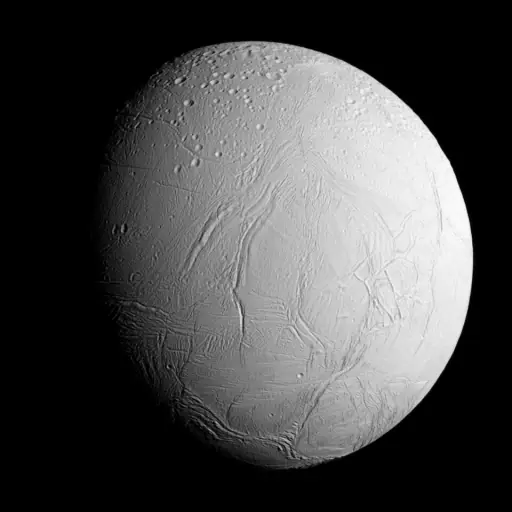
A snow-white moon that sprays its hidden ocean into space from geysers at its south pole.
Enceladus is one of the most reflective objects in the Solar System, coated in fresh, clean snow. Even at noon its surface stays near −198 °C. Yet when Cassini began flying close by in 2005, it found this small, frozen moon hard at work: from fractures near its south pole, more than 100 geysers shoot jets of water vapour and ice into space.
The jets come from an ocean of liquid water beneath the ice, kept warm by tides as Enceladus and its neighbour Dione tug on each other in a steady rhythm. Cassini flew through the spray and tasted it — salt, hydrogen and signs of hot water reacting with rock on the sea floor. Some scientists think microbes like those around Earth’s deep-sea vents could live there.
Some of the spray falls back as snow, now hundreds of metres deep. The rest escapes to supply most of Saturn’s faint, wide E ring.
Did you know?
- Found on first light. William Herschel discovered Enceladus on 28 August 1789, during the first use of his 40-foot telescope, then the largest in the world.
- 200 kg every second. Together, the geysers of Enceladus blast about 200 kilograms of material into space every second.
- Names from the Arabian Nights. Features on Enceladus are named after characters and places in Richard Burton’s 1885 translation of The Book of One Thousand and One Nights.
How big is it?
Our Moon could hold 327 moons this size. Enceladus is 504 km across — 15% of our Moon’s width. It has about 1/680 of our Moon’s mass. A 70 kg person would feel like 0.8 kg on its surface.
Icy geysers feed Saturn's E ring. Look for it near its greatest distance from the rings.
Other moons of Saturn: Mimas, Tethys, Dione, Rhea, Titan, Hyperion, Iapetus.
Open AstroPilot to see where Enceladus is next to Saturn tonight and how easy it is with your telescope.