Tethys
Tethys (Saturn III) is a moon of Saturn, discovered by Giovanni Cassini in 1684. It orbits Saturn every 45 hours and shines at about magnitude 10.2.
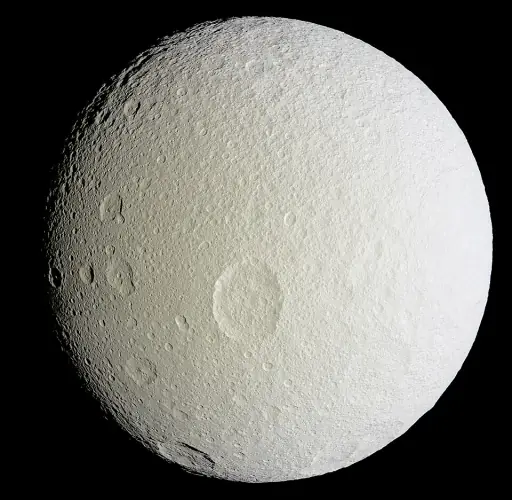
Saturn’s ice-white moon, marked by a giant crater and a canyon named for Odysseus’s home.
Tethys is about as close as a moon gets to a giant snowball. Its density is the lowest of any major moon in the Solar System, just under that of water, so it must be almost pure ice with only a little rock. And it gleams: its surface is one of the most reflective known, sandblasted clean by ice grains from Saturn’s E ring, which the geysers of Enceladus keep supplying.
Two great scars mark it. Odysseus is an impact crater spanning more than a third of the moon’s width, and Ithaca Chasma, a rift valley about 100 km wide, runs for more than 2,000 km. The two may be related. Both take their names from Homer’s Odyssey.
Giovanni Domenico Cassini found Tethys in 1684 with a giant aerial telescope — a lens mounted high on a pole, with no tube — in the grounds of the Paris Observatory.
Did you know?
- Two moons share its orbit. Two tiny moons, Telesto and Calypso, travel along Tethys’s orbit, one 60° ahead of it and one 60° behind, at balance points known as Lagrange points.
- Heavier than all smaller moons. Although it is mostly ice, Tethys outweighs all the known moons smaller than itself put together.
- The stars of Louis. Cassini honoured King Louis XIV by calling the four moons he found Sidera Lodoicea, ‘the stars of Louis’. The modern names came from John Herschel in 1847.
How big is it?
Our Moon could hold 35 moons this size. Tethys is 1,062 km across — 31% of our Moon’s width. It has about 1/119 of our Moon’s mass. A 70 kg person would feel like 1 kg on its surface.
An icy moon split by a vast canyon; with Dione and Rhea, part of the trio a 4-inch scope shows.
Other moons of Saturn: Mimas, Enceladus, Dione, Rhea, Titan, Hyperion, Iapetus.
Open AstroPilot to see where Tethys is next to Saturn tonight and how easy it is with your telescope.