Titan
Titan (Saturn VI) is a moon of Saturn, discovered by Christiaan Huygens in 1655. It orbits Saturn every 15.9 days and shines at about magnitude 8.4.
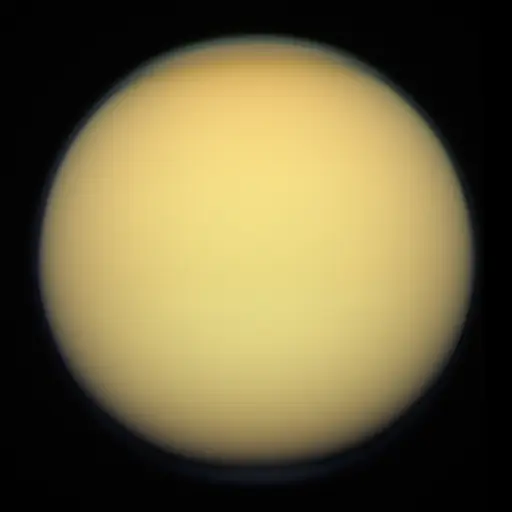
A moon with orange skies, methane rain, rivers and seas — the most Earth-like world we know, at −179 °C.
On Titan the air is thicker than on Earth and the sky is a dim orange haze. It rains here — not water but liquid methane. Wind and rain have shaped rivers, dunes and deltas, and near the poles lie lakes and seas, all at about −179 °C. Titan is the only moon with a dense atmosphere, and the only world besides Earth known to have stable bodies of liquid on its surface.
Saturn’s largest moon is second in size only to Jupiter’s Ganymede. Christiaan Huygens discovered it in 1655 with a telescope he built with his brother Constantijn — the first moon of Saturn ever found. He called it simply Saturni Luna, ‘moon of Saturn’; the name Titan came from John Herschel in 1847.
On 14 January 2005, the European Huygens probe, carried there by Cassini, parachuted through the haze and landed on a plain strewn with rounded pebbles of ice — still the most distant landing ever made. NASA’s Dragonfly, a flying rotorcraft, is due to follow.
Did you know?
- Bigger than Mercury, but lighter. Titan is wider than the planet Mercury, yet has only about 40% of its mass: Titan is mostly ice, while Mercury is iron and rock.
- Saturn fills the sky. Seen from Titan, Saturn would look more than ten times as wide as our Moon does from Earth — if only the thick haze would let you see it.
- Hyperion’s parent?. Computer simulations suggest a mid-sized moon collided with Titan a few hundred million years ago, and that the debris may have gathered to form the moon Hyperion.
How big is it?
Bigger than the planet Mercury. Titan is 5,149 km across — 1.5 times our Moon’s width, and wider than Mercury (4,879 km). It has 1.8 times our Moon’s mass — but less than half of Mercury’s: it’s made largely of ice. A 70 kg person would feel like 10 kg on its surface.
Saturn's giant moon, wrapped in orange haze — visible in any telescope, up to about 3′ from the planet.
Other moons of Saturn: Mimas, Enceladus, Tethys, Dione, Rhea, Hyperion, Iapetus.
Open AstroPilot to see where Titan is next to Saturn tonight and how easy it is with your telescope.