Iapetus
Iapetus (Saturn VIII) is a moon of Saturn, discovered by Giovanni Cassini in 1671. It orbits Saturn every 79.3 days and shines at about magnitude 11.0.
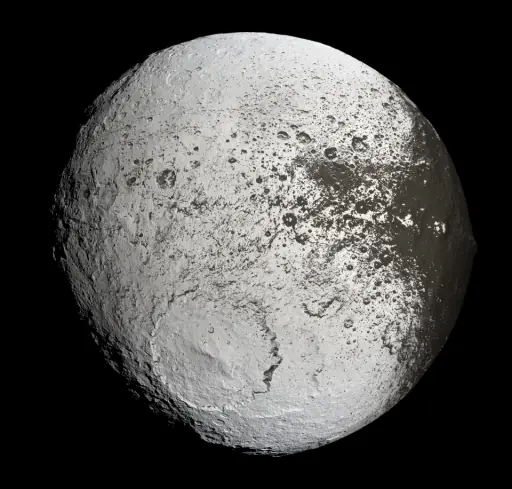
A two-faced moon, coal-dark on one side and snow-bright on the other, with a ridge around its waist.
In 1671 Giovanni Domenico Cassini found a new moon west of Saturn. But when it swung round to the eastern side, it vanished. The same thing happened the next year. Cassini guessed why: one half of the moon is bright and the other dark, and it always keeps the same face turned to Saturn. He was right. Only in 1705, with a better telescope, did he catch it on the eastern side, two magnitudes fainter.
Iapetus is still the strangest-looking of Saturn’s large moons. Its leading side is as dark as coal, its trailing side bright with ice. A ridge runs three-quarters of the way around its equator, giving it the look of a walnut. And from its tilted, faraway orbit, it is the only large moon from which Saturn’s rings would be clearly seen, rather than edge-on.
Did you know?
- A Star Gate in fiction. In Arthur C. Clarke’s novel 2001: A Space Odyssey, the alien Star Gate waits on Iapetus, spelled Japetus. The film moved the scene to Jupiter.
- The most distant locked moon. Iapetus orbits far beyond Titan, yet still keeps one face toward Saturn. No other tidally locked moon in the Solar System orbits so far from its planet.
- Names from The Song of Roland. Geological features on Iapetus are named after characters and places from the French epic poem The Song of Roland.
How big is it?
Our Moon could hold 13 moons this size. Iapetus is 1,469 km across — 42% of our Moon’s width. It has 2% of our Moon’s mass. A 70 kg person would feel like 1.6 kg on its surface.
Two-faced: one hemisphere is coal-dark, the other bright, so it is two magnitudes brighter west of Saturn than east.
Other moons of Saturn: Mimas, Enceladus, Tethys, Dione, Rhea, Titan, Hyperion.
Open AstroPilot to see where Iapetus is next to Saturn tonight and how easy it is with your telescope.