Hyperion
Hyperion (Saturn VII) is a moon of Saturn, discovered by William Bond and William Lassell in 1848. It orbits Saturn every 21.3 days and shines at about magnitude 14.2.
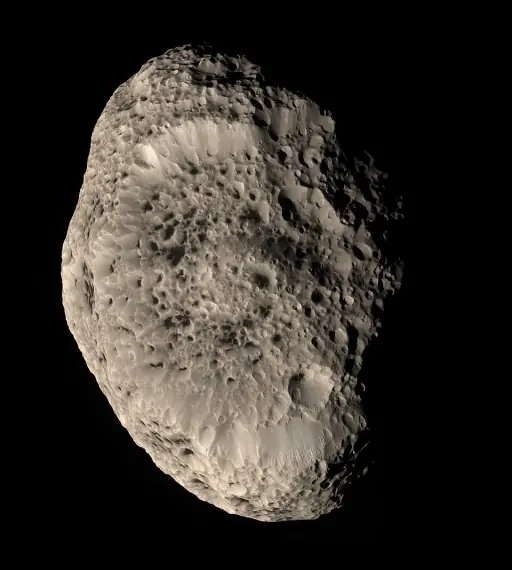
A tumbling, sponge-like moon that is about 40 percent empty space.
Hyperion looks like a giant sponge. Deep, sharp-edged craters riddle its surface, each with dark, reddish material pooled in the bottom. The reason is what it is made of: mostly water ice, packed so loosely that about 40% of the moon is empty space. Impacts tend to crush the surface rather than blast it out, and with gravity this weak, most of the debris never falls back.
It also tumbles. Hyperion is the only regular moon known not to keep one face turned to its planet, and its spin is chaotic: its axis wobbles so much that its orientation soon becomes impossible to predict. Its lumpy shape, its stretched orbit and regular tugs from giant Titan all play a part. It may be a fragment of a larger moon, shattered by an ancient impact.
Did you know?
- Two discoveries, two days apart. William Bond and his son George found Hyperion in the United States in September 1848. William Lassell, in England, saw it two days later — and beat them to publication.
- The first lumpy moon. Hyperion was the first moon ever discovered that is not round, and it is still one of the largest irregularly shaped bodies known.
- God of watchfulness. Hyperion is named after the Titan god of watchfulness and observation, an elder brother of Cronus. Lassell suggested the name.
How big is it?
Our Moon could hold 2,130 moons this size. Hyperion is 270 km across — 8% of our Moon’s width. It has about 1/13,000 of our Moon’s mass. A 70 kg person would feel like 0.1 kg on its surface.
A tumbling, sponge-like moon. At magnitude 14 it is a quarry for large telescopes.
Other moons of Saturn: Mimas, Enceladus, Tethys, Dione, Rhea, Titan, Iapetus.
Open AstroPilot to see where Hyperion is next to Saturn tonight and how easy it is with your telescope.