Dione
Dione (Saturn IV) is a moon of Saturn, discovered by Giovanni Cassini in 1684. It orbits Saturn every 2.7 days and shines at about magnitude 10.4.
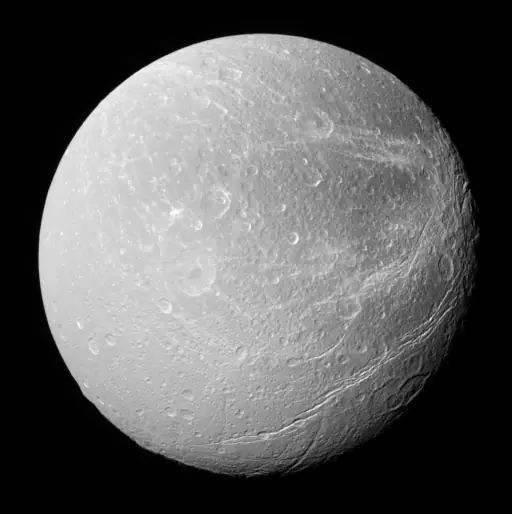
An icy moon whose mysterious ‘wispy’ streaks turned out to be cliffs of ice.
When Voyager 1 photographed Dione in 1980, one side of the moon was laced with bright, wispy streaks. Nobody knew what they were. The favourite idea was frost or ash from ancient eruptions, sprayed out along cracks. Then, in December 2004, Cassini took a close look. The wisps were not deposits at all, but bright cliffs of ice, some several hundred metres high, lining enormous fractures in the crust.
Saturn’s fourth-largest moon is roughly half rock and half ice. It orbits Saturn at almost the same distance as our Moon orbits Earth, yet goes round ten times as fast, because Saturn is so much more massive. It also keeps its neighbour busy: for every orbit Dione makes, Enceladus makes two, and that steady rhythm helps heat Enceladus and power its geysers. Dione may even hide an ocean of its own.
Did you know?
- Two moons along for the ride. Two small trojan moons, Helene and Polydeuces, share Dione’s orbit, riding 60° ahead of it and 60° behind.
- A ridge that bends the crust. Dione’s ridge Janiculum Dorsa rises about 1.5 km, and the crust sags beneath it in a way most easily explained by liquid water below.
- Rhea’s smaller sibling. Apart from being somewhat smaller and denser, Dione is very like Rhea: both have bright ice cliffs, and both have leading and trailing sides that look quite different.
How big is it?
Our Moon could hold 30 moons this size. Dione is 1,123 km across — 32% of our Moon’s width. It has 1% of our Moon’s mass. A 70 kg person would feel like 1.7 kg on its surface.
Bright ice cliffs streak its trailing side; usually found between Tethys and Rhea.
Other moons of Saturn: Mimas, Enceladus, Tethys, Rhea, Titan, Hyperion, Iapetus.
Open AstroPilot to see where Dione is next to Saturn tonight and how easy it is with your telescope.