Rhea
Rhea (Saturn V) is a moon of Saturn, discovered by Giovanni Cassini in 1672. It orbits Saturn every 4.5 days and shines at about magnitude 9.7.
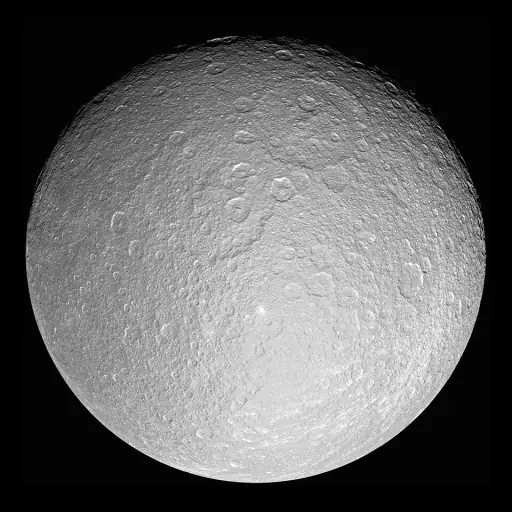
Saturn’s second-largest moon — a cold, cratered ice world wrapped in a whisper of oxygen.
Rhea is a world of ice and old craters. Saturn’s second-largest moon is roughly three-quarters water ice and one-quarter rock, and its surface temperature swings between about −174 °C and −220 °C. Like its smaller neighbour Dione, it is streaked with bright cliffs of ice, and it always keeps the same face turned to Saturn.
It is the smallest body in the Solar System confirmed to have the balanced, rounded shape that gravity alone would give it, and its surface area is about that of Australia. In 2010 Cassini, swooping close, detected a whisper-thin atmosphere of oxygen and carbon dioxide — the oxygen freed from the ice by Saturn’s radiation.
Giovanni Domenico Cassini discovered Rhea on 23 December 1672 with a telescope more than 10 metres long, made by Giuseppe Campani. It was only the third moon of Saturn ever found.
Did you know?
- Mother of the gods. Rhea was the Titaness who married Cronus — the Greek counterpart of Saturn — and bore the first generation of Olympian gods.
- The rings that weren’t. In 2008 Cassini’s instruments hinted that Rhea might have rings of its own, the first known around a moon. Later searches with Cassini’s cameras found no sign of them.
- Oberon’s near-twin. Rhea is almost exactly the size of Uranus’s moon Oberon, but Oberon is denser, so it is the heavier of the two.
How big is it?
Our Moon could hold 12 moons this size. Rhea is 1,528 km across — 44% of our Moon’s width. It has 3% of our Moon’s mass. A 70 kg person would feel like 1.9 kg on its surface.
Saturn's second-largest moon and the easiest after Titan.
Other moons of Saturn: Mimas, Enceladus, Tethys, Dione, Titan, Hyperion, Iapetus.
Open AstroPilot to see where Rhea is next to Saturn tonight and how easy it is with your telescope.