Umbriel
Umbriel (Uranus II) is a moon of Uranus, discovered by William Lassell in 1851. It orbits Uranus every 4.1 days and shines at about magnitude 14.9.
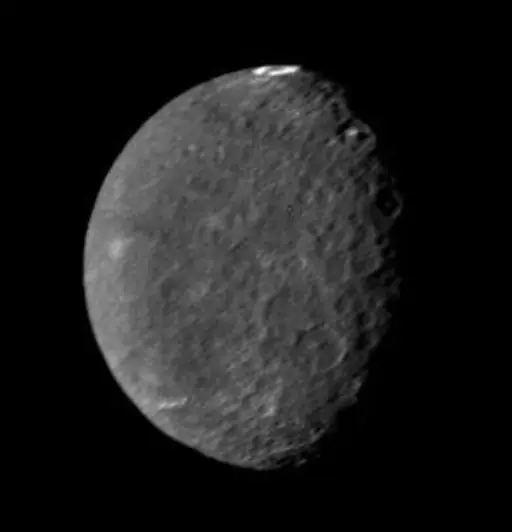
The darkest of Uranus’s big moons, named after a gloomy sprite and marked by one bright ring.
Umbriel is the ‘dusky melancholy sprite’ of Alexander Pope’s poem The Rape of the Lock, and its name echoes the Latin umbra, ‘shadow’. It suits the moon. Umbriel has the darkest surface of Uranus’s large moons, an old, heavily cratered landscape of ice mixed with a good deal of rock.
One feature breaks the gloom: a ring of bright material on the floor of the crater Wunda, the most prominent mark on the moon. Canyons hint that Umbriel was once active inside, and it may have been resurfaced early on, wiping out an even older face.
William Lassell discovered Umbriel on 24 October 1851, the same night as Ariel. Only Voyager 2 has seen it up close, in January 1986, mapping about 40% of its surface.
Did you know?
- Shadow play in 2007. Around Uranus’s 2007 equinox, Umbriel was seen passing in front of Titania twice, on 15 August and 8 December.
- A heater for Miranda?. Early in its history Umbriel may have been in a 1:3 orbital resonance with Miranda, stretching Miranda’s orbit and helping to heat that moon from within.
- Battered. After Oberon, Umbriel is the most heavily cratered moon of Uranus, with impact craters up to 210 km across.
How big is it?
Our Moon could hold 26 moons this size. Umbriel is 1,169 km across — 34% of our Moon’s width. It has 2% of our Moon’s mass. A 70 kg person would feel like 1.8 kg on its surface.
The darkest of the large Uranian moons, and the hardest of the four to catch.
Other moons of Uranus: Miranda, Ariel, Titania, Oberon.
Open AstroPilot to see where Umbriel is next to Uranus tonight and how easy it is with your telescope.