Miranda
Miranda (Uranus V) is a moon of Uranus, discovered by Gerard Kuiper in 1948. It orbits Uranus every 34 hours and shines at about magnitude 16.3.
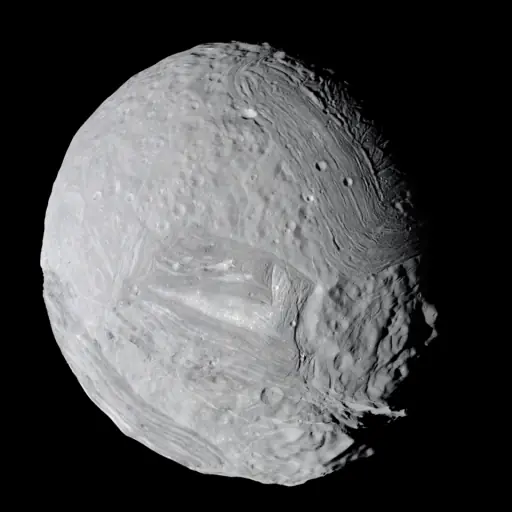
A small moon that looks stitched together from scraps — with what may be the tallest cliff in the Solar System.
When Voyager 2 sped past Uranus in January 1986, the team expected Miranda to look like Saturn’s Mimas: a plain, cratered ball. Instead it was a patchwork of grooved, chevron-shaped regions called coronae, jumbled terrain and Verona Rupes, a cliff about 20 km high that may be the tallest in the Solar System. With only a day before the pictures went to the press, the scientists were at a loss to explain it.
Decades later, several explanations still compete. One idea is that Miranda was once caught in an orbital resonance with Umbriel, which stretched its orbit, heated its interior and left it with an unusually tilted path. Only its southern half has ever been seen up close: during the flyby, the north lay in darkness.
Gerard Kuiper discovered Miranda, the smallest and innermost of Uranus’s five round moons, in 1948 at McDonald Observatory in Texas — the first new moon of Uranus found in nearly a century.
Did you know?
- A human among fairies. Kuiper named it after Miranda in Shakespeare’s The Tempest. Uranus’s earlier moons were named for fairies and spirits; Miranda was the first human.
- A Texas-sized moon. Miranda’s whole surface area is roughly equal to that of the US state of Texas — where, fittingly, it was discovered.
How big is it?
Our Moon could hold 400 moons this size. Miranda is 472 km across — 14% of our Moon’s width. It has about 1/1,150 of our Moon’s mass. A 70 kg person would feel like 0.5 kg on its surface.
The smallest and closest of Uranus's major moons — an extreme target for the largest amateur scopes.
Other moons of Uranus: Ariel, Umbriel, Titania, Oberon.
Open AstroPilot to see where Miranda is next to Uranus tonight and how easy it is with your telescope.