Oberon
Oberon (Uranus IV) is a moon of Uranus, discovered by William Herschel in 1787. It orbits Uranus every 13.5 days and shines at about magnitude 14.0.
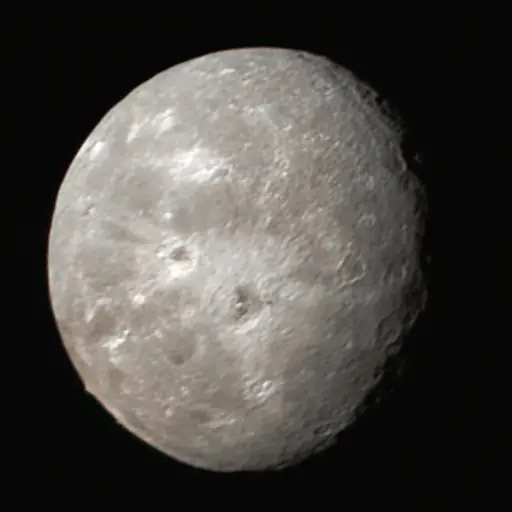
King of the fairies — the outermost of Uranus’s large moons, old, dark and battered.
Oberon is the outermost of Uranus’s five large moons and the most heavily cratered, its dark, slightly red surface shaped mostly by asteroid and comet impacts. Long chasms crack the crust where the young moon’s interior expanded and stretched it. Inside, it is probably a rocky core under an icy mantle, perhaps with a thin layer of liquid water where the two meet.
Its distant orbit sets it apart. For part of each orbit Oberon lies outside Uranus’s magnetic bubble, where the solar wind strikes it directly. It is also the only large Uranian moon whose trailing side is not darkened; on the others, the planet’s charged particles are thought to be to blame.
William Herschel discovered Oberon on 11 January 1787, the same night as Titania — fittingly, as Oberon is Titania’s husband, king of the fairies in A Midsummer Night’s Dream. For nearly fifty years, no telescope but Herschel’s own saw either moon.
Did you know?
- Moon passes moon. On 4 May 2007, during Uranus’s equinox season, Oberon was seen passing in front of Umbriel, an event that lasted about six minutes.
- One flyby, 40% mapped. Voyager 2 photographed Oberon in January 1986, mapping about 40% of its surface. No spacecraft has been back since.
How big is it?
Our Moon could hold 12 moons this size. Oberon is 1,523 km across — 44% of our Moon’s width. It has 4% of our Moon’s mass. A 70 kg person would feel like 2.5 kg on its surface.
The outermost large moon of Uranus, usually the easiest to separate from the planet.
Other moons of Uranus: Miranda, Ariel, Umbriel, Titania.
Open AstroPilot to see where Oberon is next to Uranus tonight and how easy it is with your telescope.