Ariel
Ariel (Uranus I) is a moon of Uranus, discovered by William Lassell in 1851. It orbits Uranus every 2.5 days and shines at about magnitude 14.3.
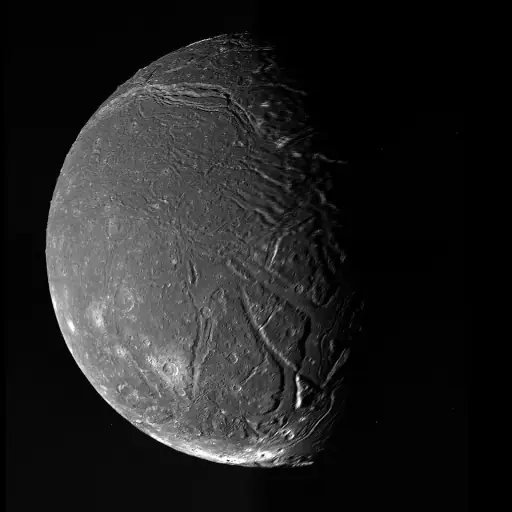
Named after a spirit of the air — the Uranian moon with the freshest-looking face.
Ariel takes its name from two airy spirits: the leading sylph in Alexander Pope’s The Rape of the Lock, and the sprite who serves Prospero in Shakespeare’s The Tempest. William Lassell discovered it on 24 October 1851, the same night as its neighbour Umbriel.
Made of roughly equal parts ice and rock, Ariel has the freshest-looking face of Uranus’s large moons. Its old cratered plains are cut by scarps, canyons and ridges, signs of more recent geological activity than on its siblings. Tidal heating is the likely cause, perhaps from an ancient orbital resonance with Titania that has since broken.
Like Uranus itself, Ariel is tipped on its side relative to the Sun, so each pole spends 42 years in sunlight and then 42 in darkness. When Voyager 2 flew by in 1986 it was midsummer in the south, and only about 35% of the moon could be imaged.
Did you know?
- Moons in front of moons. Once every 42 years, when Uranus’s moons orbit edge-on to us, they can pass in front of one another. On 19 August 2007, Umbriel was seen crossing in front of Ariel in a rare mutual occultation.
- Who chose the names?. John Herschel suggested names for Uranus’s four then-known moons in 1852, at Lassell’s request — though it is unclear whether Herschel or Lassell actually picked them.
- The weight of our oceans. Ariel’s mass is roughly the same as that of all the water on Earth — our planet’s entire hydrosphere.
How big is it?
Our Moon could hold 27 moons this size. Ariel is 1,158 km across — 33% of our Moon’s width. It has 2% of our Moon’s mass. A 70 kg person would feel like 1.8 kg on its surface.
The brightest-surfaced of Uranus's moons, but close in: steady air and high power help.
Other moons of Uranus: Miranda, Umbriel, Titania, Oberon.
Open AstroPilot to see where Ariel is next to Uranus tonight and how easy it is with your telescope.