Io
Io (Jupiter I) is a moon of Jupiter, discovered by Galileo Galilei in 1610. It orbits Jupiter every 42 hours and shines at about magnitude 5.0.
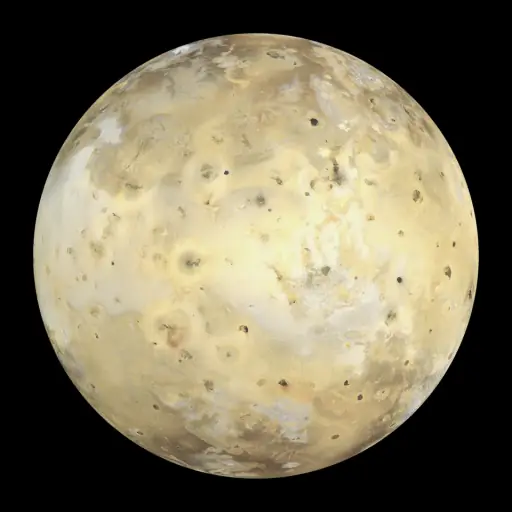
The most volcanic world in the Solar System — a moon squeezed by Jupiter until lava pours out.
Picture a moon painted yellow, red, white and black — the colours of sulfur, laid down by eruption after eruption. Io, innermost of the four Galilean moons, has more than 400 active volcanoes, making it the most geologically active world in the Solar System. Some fling plumes of sulfur hundreds of kilometres above the surface, lava flows run for hundreds more, and some of its mountains stand taller than Everest.
The fire comes from a tug of war. Io is caught between Jupiter and its sibling moons Europa and Ganymede, whose regular pulls keep its orbit slightly stretched. As Io swings closer to Jupiter and away again, the giant planet’s gravity flexes it, and the friction heats its interior. Unlike most moons of the outer Solar System, Io is made of rock rather than ice.
Nobody suspected any of this until 1979, when Voyager 1 sent back pictures of a young face with no obvious impact craters and a plume rising above its edge — the first active volcanoes ever seen beyond Earth.
Did you know?
- Timing the speed of light. In 1676 Ole Rømer noticed that Io’s eclipses behind Jupiter came early or late depending on how far Earth was from Jupiter. The difference was light’s travel time — the first measurement of the speed of light.
- Names from Dante’s Inferno. Io’s features are named after gods of fire, volcanoes, the Sun and thunder, characters from the myth of Io, and places from Dante’s Inferno.
- A ring of radiation. Gas from Io’s volcanoes feeds a vast doughnut of charged particles around Jupiter, the Io plasma torus, bathing the moon in fierce radiation.
- Bone dry. Io has less water, by atomic ratio, than any other known object in the Solar System.
How big is it?
About the size of our own Moon. Io is 3,643 km across — 105% of our Moon’s width. It has 1.2 times our Moon’s mass. A 70 kg person would feel like 13 kg on its surface.
The most volcanic world known. It circles Jupiter in 42 hours, so its place changes visibly in an evening.
Other moons of Jupiter: Europa, Ganymede, Callisto.
Open AstroPilot to see where Io is next to Jupiter tonight and how easy it is with your telescope.