Callisto
Callisto (Jupiter IV) is a moon of Jupiter, discovered by Galileo Galilei in 1610. It orbits Jupiter every 16.7 days and shines at about magnitude 5.6.
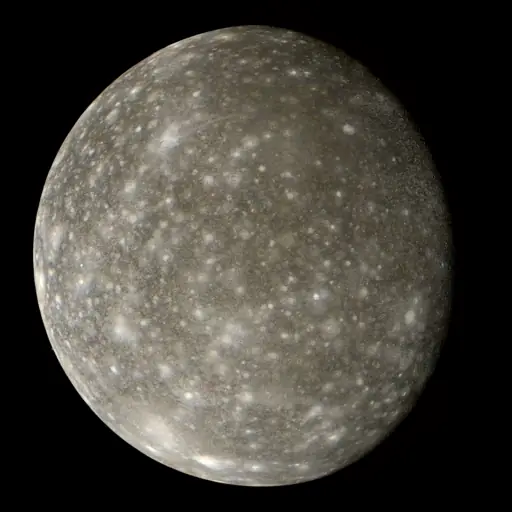
The most heavily cratered world known — a battered ball of ice and rock, and the safest harbour at Jupiter.
Callisto keeps a record of almost everything that ever hit it. Its surface is the oldest and most heavily cratered in the Solar System, nearly covered in craters, with no volcanoes or drifting plates to wipe them away. Giant bull’s-eye scars called multi-ring basins mark the biggest impacts, and chains of craters trail across the ice.
It is the outermost of the four Galilean moons, and the quietest. Unlike Io, Europa and Ganymede, it is not locked in an orbital resonance, so Jupiter’s tides barely warm it, and the rock and ice inside it never fully separated. Even so, the Galileo spacecraft found hints of an ocean of liquid water deep below the surface.
Its distance from Jupiter has one great advantage: it lies just outside the planet’s main radiation belt. That has long made Callisto the favourite site for any future crewed base in the Jupiter system.
Did you know?
- Sparkling frost. Up close, Callisto’s high points are tipped with small, sparkly frost deposits, surrounded by a smooth, low-lying blanket of dark material.
- A nymph turned into a bear. In Greek myth Callisto was a nymph who hunted with the goddess Artemis. She was turned into a bear and placed among the stars as the Great Bear.
- Almost a Mercury. Callisto is nearly as wide as the planet Mercury but has only about a third of its mass, because it is roughly half ice.
How big is it?
1.4 times as wide as our Moon. Callisto is 4,821 km across — 1.4 times our Moon’s width. It has 1.5 times our Moon’s mass. A 70 kg person would feel like 9 kg on its surface.
Ancient, dark and cratered; it strays farthest from Jupiter, up to about 10′ away.
Other moons of Jupiter: Io, Europa, Ganymede.
Open AstroPilot to see where Callisto is next to Jupiter tonight and how easy it is with your telescope.