Europa
Europa (Jupiter II) is a moon of Jupiter, discovered by Galileo Galilei in 1610. It orbits Jupiter every 3.6 days and shines at about magnitude 5.3.
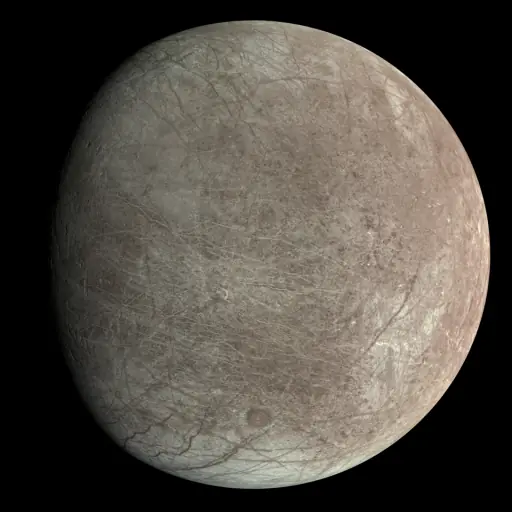
A cracked shell of ice over a hidden ocean — one of the best places to look for life beyond Earth.
Europa looks like a cracked eggshell. Its pale surface is criss-crossed by tan streaks and cracks, yet it has almost no craters or mountains, making it the smoothest solid object known in the Solar System. Something keeps renewing it. Beneath the ice lies an ocean of liquid water, kept from freezing by the flexing of Jupiter’s tides, and the ice above may slowly shift like Earth’s drifting plates.
That ocean makes this moon, a little smaller than our own, one of the most promising places to search for life. Sea salt seems to stain parts of the surface, hinting that the water touches a rocky sea floor. Hubble has spotted signs of water vapour plumes venting into space — a chance to sample the ocean without ever landing.
No spacecraft has landed yet. NASA’s Europa Clipper, launched in October 2024, is on its way to make dozens of close passes, and Europe’s Juice will fly by twice.
Did you know?
- One light, then two. On 7 January 1610 Galileo saw Io and Europa merged as a single point of light. The next night they had separated, and Europa was seen on its own for the first time.
- Named for a princess. Europa was a Phoenician princess courted by Zeus, who became queen of Crete. Simon Marius gave the moon her name, crediting the idea to Johannes Kepler.
- Air made by radiation. Europa has a very thin atmosphere made mostly of oxygen. It comes not from life but from Jupiter’s radiation breaking apart the surface ice.
- A close pass by Juno. In September 2022 NASA’s Juno spacecraft flew within about 320 km of Europa’s icy surface, the closest look since the Galileo mission.
How big is it?
Our Moon could hold 1.4 moons this size. Europa is 3,122 km across — 90% of our Moon’s width. It has 65% of our Moon’s mass. A 70 kg person would feel like 9 kg on its surface.
Smooth ice over a hidden ocean — the smallest and faintest of the four Galilean moons.
Other moons of Jupiter: Io, Ganymede, Callisto.
Open AstroPilot to see where Europa is next to Jupiter tonight and how easy it is with your telescope.