Ganymede
Ganymede (Jupiter III) is a moon of Jupiter, discovered by Galileo Galilei in 1610. It orbits Jupiter every 7.2 days and shines at about magnitude 4.6.
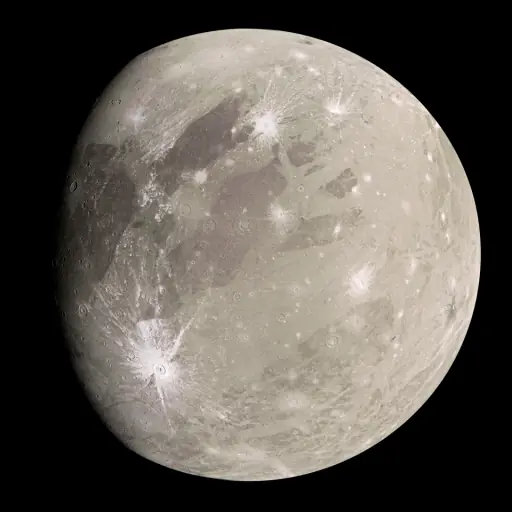
The largest moon in the Solar System — bigger than Mercury, with its own magnetic field and a hidden sea.
If Ganymede circled the Sun instead of Jupiter, we might well call it a planet. It is the largest moon in the Solar System, wider than Mercury, though lighter, being roughly half rock and half water. It is also the only moon known to generate its own magnetic field, probably stirred up in a liquid, iron-rich core.
Under its icy crust lies an ocean that may hold more water than all of Earth’s oceans combined. The surface tells two stories: dark, ancient regions crowded with craters about four billion years old, and lighter terrain, covering two-thirds of the moon, scored with long grooves and ridges.
Galileo first saw it in January 1610 as one of three ‘stars’ beside Jupiter. Simon Marius named it after Ganymede, the Trojan prince Zeus carried off to be cupbearer to the gods — the only male among the four Galilean moons. Europe’s Juice spacecraft, launched in 2023, is set to become the first ever to orbit a moon other than our own.
Did you know?
- A sighting in 365 BC?. Chinese records say that in 365 BC the astronomer Gan De saw a small reddish star beside Jupiter. It may have been Ganymede, glimpsed with the naked eye — though the colour is a puzzle.
- The ‘Jupiter of Jupiter’. Before settling on mythological names, Simon Marius tried calling the moons the Mercury, Venus, Jupiter and Saturn of Jupiter. Ganymede was the ‘Jupiter of Jupiter’.
- Auroras that betray an ocean. Ganymede’s magnetic field gives it auroras. In 2015 Hubble showed that they sway less than expected — the damping effect of a salty ocean hidden under the ice.
How big is it?
Bigger than the planet Mercury — the largest moon in the Solar System. Ganymede is 5,268 km across — 1.5 times our Moon’s width, and wider than Mercury (4,879 km). It has twice our Moon’s mass — but less than half of Mercury’s: it’s made largely of ice. A 70 kg person would feel like 10 kg on its surface.
The largest moon in the Solar System, bigger than Mercury; its shadow on Jupiter is the easiest to see.
Other moons of Jupiter: Io, Europa, Callisto.
Open AstroPilot to see where Ganymede is next to Jupiter tonight and how easy it is with your telescope.