Saturn
Saturn is a planet of the Solar System. The rings, Cassini division and Titan; spectacular at any magnification above ~50×.
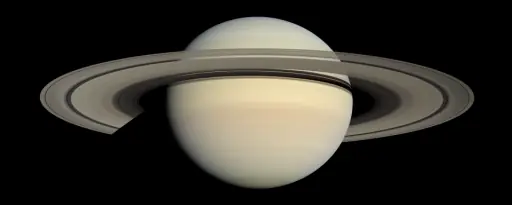
A planet light enough to float, crowned with rings of ice and a six-sided storm at its pole.
Galileo was baffled. In 1610 his small telescope showed Saturn with two mysterious lumps, one on either side. Two years later they had vanished. It took Christiaan Huygens, with a better telescope in the 1650s, to see the truth: a thin, flat ring circling the planet without touching it. Those rings are made mostly of water ice, in pieces from dust grains to boulders, and when Earth passes through their plane they all but disappear — which is what fooled Galileo.
Beneath them lies a planet made almost entirely of hydrogen and helium, with no surface to stand on. It is the only planet less dense than water: in a large enough ocean, Saturn would float. A day lasts only about ten and a half hours, a spin fast enough to squash the planet visibly, and its winds reach 1,800 km/h. Deep inside, droplets of helium may be raining down — and perhaps even diamonds.
About once every Saturnian year — roughly 30 of ours — a Great White Spot erupts. The latest, in 2010, grew until it wrapped around the whole planet, watched from orbit by the Cassini spacecraft.
Did you know?
- A hexagon at the pole. Around Saturn’s north pole the clouds form a six-sided jet stream, first seen in Voyager images in the early 1980s and studied for years by Cassini. Each side is wider than Earth.
- A warm storm at the south pole. Saturn’s south pole has a warm polar vortex, a vast hurricane-like storm. It is the only known example of such a vortex in the Solar System.
- A planned plunge. After thirteen years in orbit, Cassini ended its mission on 15 September 2017 by diving into Saturn on purpose, so that it could never crash into and contaminate Enceladus or Titan.
- Saturn’s day. The Romans named the seventh day of the week after the planet: Saturday comes from Sāturni diēs, ‘Saturn’s day’.
How big is it?
764 Earths could fit inside Saturn. Saturn is 9.1 times as wide as Earth — 116,464 km across. It weighs as much as 95 Earths, yet it’s lighter than water for its size: in a big enough ocean it would float. A 70 kg person would feel like 74 kg at its cloud tops — there’s no ground to stand on. A whole day lasts just 10 h 39 min, so fast that Saturn bulges at its equator.
In November 2026 Saturn is in the evening sky, 122° from the Sun, at magnitude 0.6 in Cetus.
Its place changes from night to night: open AstroPilot for tonight's rise, set and best time from your location.