Phobos
Phobos (Mars I) is a moon of Mars, discovered by Asaph Hall in 1877. It orbits Mars every 8 hours and shines at about magnitude 11.5.
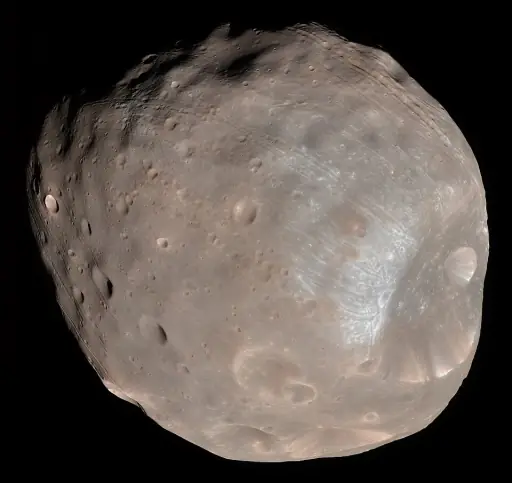
A dark, lumpy moon racing round Mars faster than Mars spins — and slowly falling towards it.
Stand on Mars and watch Phobos: it rises in the west, races across the sky in about four hours and sets in the east, twice each Martian day. It orbits closer to its planet than any other known moon, circling every 7 hours 39 minutes — faster than Mars itself turns.
Phobos is a small, irregular lump of dark, carbon-rich material, one of the least reflective objects in the Solar System. One impact crater, Stickney, takes up a large part of its surface; the blow that made it nearly shattered the moon. Phobos may be a rubble pile held together by a thin crust, and it is doomed. Mars’s tides are drawing it inward by about 2 cm a year, and in tens of millions of years it will be torn apart or crash.
Asaph Hall found it on 18 August 1877 with the 26-inch ‘Great Equatorial’ at the US Naval Observatory, then the world’s largest refracting telescope, a few days after finding Deimos.
Did you know?
- Named for a determined wife. Stickney crater carries the maiden name of Angeline Stickney Hall, Asaph Hall’s wife, who urged him to keep searching when he was close to giving up.
- Hollow Phobos. Around 1958, Iosif Shklovsky studied Phobos’s odd orbit and suggested it might be hollow — even artificial. Later measurements found nothing so strange.
- A piece of Phobos on Earth?. The unusual Kaidun meteorite, which fell on a Soviet military base in Yemen in 1980, may be a piece of Phobos — but nobody can yet prove it.
How big is it?
Only 22 km across: you could drive across it in 13 minutes. Phobos is 22 km across — 1% of our Moon’s width. It has about 1/6.9 million of our Moon’s mass. Its gravity is so weak that a thrown ball would leave it for ever: escape speed is just 11 m/s (41 km/h).
A tiny moonlet that rounds Mars three times a day. Only near opposition, with a large scope and Mars just outside the field.
Other moons of Mars: Deimos.
Open AstroPilot to see where Phobos is next to Mars tonight and how easy it is with your telescope.