Deimos
Deimos (Mars II) is a moon of Mars, discovered by Asaph Hall in 1877. It orbits Mars every 30 hours and shines at about magnitude 12.4.
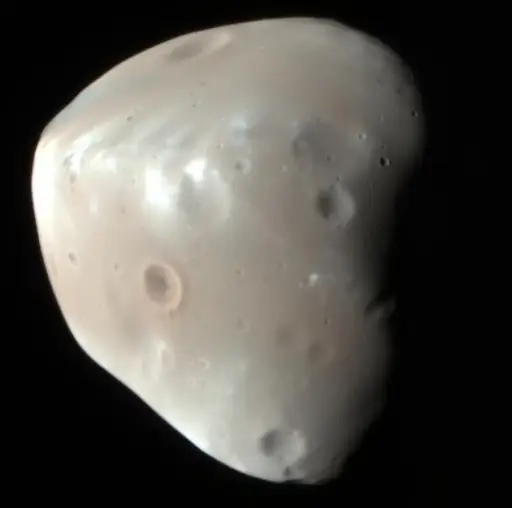
Mars’s smaller moon — named for dread, imagined by satirists, and slowly drifting away.
Long before anyone saw them, writers gave Mars two moons. In Gulliver’s Travels, published in 1726, Jonathan Swift had the astronomers of Laputa discover a pair of them, and Voltaire repeated the idea. Then, in August 1877, Asaph Hall, searching specifically for Martian moons, found Deimos. Its only two named features are craters called Swift and Voltaire.
Deimos is a tiny grey lump of carbon-rich rock, its craters softened by a blanket of loose dust. From Mars it would look almost like a star, yet at its brightest it would shine like Venus does for us. It rises in the east and takes about two and a half days to cross the sky, and from time to time it slides across the Sun as a small black dot — a miniature transit.
Unlike Phobos, which is falling inward, Deimos is slowly moving outward. One day it is expected to escape Mars altogether.
Did you know?
- Fear and Dread. Henry Madan, a science master at Eton, took the names from Book XV of Homer’s Iliad, where Ares summons Dread (Deimos) and Fear (Phobos).
- Born from one body?. No one knows how Mars got its moons. They may be captured asteroids, or the pieces of a single parent body shattered between one and 2.7 billion years ago.
- Throw a ball into space. The escape velocity of Deimos is only 5.6 m/s, about 20 km/h — so a well-thrown ball would leave it for ever.
How big is it?
Only 12 km across: you could drive across it in 7 minutes. Deimos is 12 km across — 0% of our Moon’s width. It has about 1/51 million of our Moon’s mass. Its gravity is so weak that you could almost jump off it: escape speed is just 6 m/s (20 km/h).
Mars's smaller, outer moon — easier than Phobos because it strays farther from the planet's glare.
Other moons of Mars: Phobos.
Open AstroPilot to see where Deimos is next to Mars tonight and how easy it is with your telescope.