Wolf-Lundmark-Melotte (WLM Galaxy)
Wolf-Lundmark-Melotte (WLM Galaxy) is a galaxy in the constellation Cetus, magnitude 10.8, 10′ × 3.5′ across.
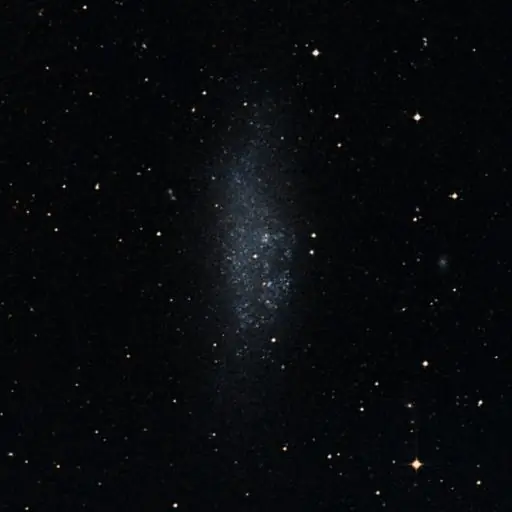
A lonely dwarf galaxy at the edge of the Local Group, named after the three astronomers who found and explained it.
Max Wolf found this faint smudge in Cetus in 1909, but it took Knut Lundmark and Philibert Melotte, in 1926, to recognise what it was. Hence its triple-barrelled name: the Wolf–Lundmark–Melotte galaxy, or WLM. It is a small, barred irregular galaxy on the outer edge of the Local Group, far enough out to have been spared mergers with other galaxies. That makes its stars a ‘pristine’ sample, useful for comparison with busier galaxies.
Wolf-Lundmark-Melotte (WLM Galaxy) is 3.2 million light-years away: the light we see from it set off about 3.2 million years ago, when our distant ancestors were making the first stone tools.
Did you know?
- A first-of-its-kind star pair. In 2024 astronomers found WLM-CB1, a candidate contact binary of two massive stars touching each other — the first such pair seen in surroundings so poor in heavy elements.
- Born in a burst. Hubble observations suggest that about half of all the stars in WLM formed in a burst that began some 13 billion years ago.
How big is it?
A dwarf beside the Milky Way. Light itself takes 9,750 years to cross it. Shrink it to the length of a football pitch and our whole Solar System would be about the size of a red blood cell.
A 10.8-magnitude barred irregular galaxy (IB) in Cetus, about 10′ × 3.6′.
When and where to see it
It is best placed in the evening sky around October, when it crosses the meridian at about 10 pm local time (around midnight in September). It can be seen from everywhere south of 75°N and never sets south of 75°S.
At its highest it stands 25° up from 50°N, 40° up from 35°N, 75° up from the equator, 70° up from 35°S.
Facts
- Type
- Galaxy
- Constellation
- Cetus
- Designations
- WLM Galaxy
- Magnitude
- 10.8
- Apparent size
- 10′ × 3.5′
- Position
- RA 0h 2.0m, Dec −15° 28′ (J2000)
- Distance
- 3.2 million light-years
- Discovered
- Max Wolf, 1909, Its nature recognised by Knut Lundmark and Philibert Melotte in 1926
Open AstroPilot to see when Wolf-Lundmark-Melotte (WLM Galaxy) is highest tonight from your location, how easy it is with your telescope or binoculars, and an eyepiece view.