NGC 7793
NGC 7793 is a galaxy in the constellation Sculptor, magnitude 9.3, 10′ × 6.0′ across.
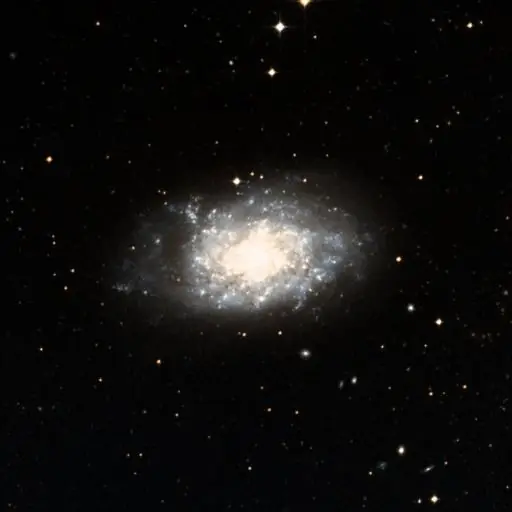
A tufted, patchy spiral in Sculptor, home to a pulsar once mistaken for a black hole.
Some spirals have clean, sweeping arms. NGC 7793 has tufts. Astronomers call it a flocculent spiral galaxy, from the Latin for a tuft of wool: its arms are short, loose and broken, around a tiny bulge with a star cluster at its heart. James Dunlop found it from New South Wales on 14 July 1826. It is one of the five brightest galaxies of the Sculptor Group, one of the nearest groups of galaxies to our own.
NGC 7793 is 13 million light-years away: the light we see from it set off about 13 million years ago, when great apes were spreading through Africa and Europe.
Did you know?
- A pulsar in disguise. Its X-ray source P13 was thought to hold a black hole. It turned out to be a pulsar spinning once every 0.42 seconds, circling a giant companion star every 64 days.
- Seen before it blew. In 2008 Berto Monard found supernova SN 2008bk here. Its parent star, a red supergiant, had been observed just 547 days before it exploded.
How big is it?
39% of the Milky Way’s width. Light itself takes 39,000 years to cross it. Shrink it to the length of a football pitch and our whole Solar System would be about the size of a red blood cell.
A 9.3-magnitude spiral galaxy (Scd) in Sculptor, about 10′ × 6.1′.
When and where to see it
It is best placed in the evening sky around October, when it crosses the meridian at about 10 pm local time (around midnight in September). It can be seen from everywhere south of 57°N and never sets south of 57°S.
At its highest it stands 7° up from 50°N, 22° up from 35°N, 57° up from the equator, 88° up from 35°S.
Facts
- Type
- Galaxy
- Constellation
- Sculptor
- Designations
- NGC 7793
- Magnitude
- 9.3
- Apparent size
- 10′ × 6.0′
- Position
- RA 23h 57.8m, Dec −32° 35′ (J2000)
- Distance
- 13 million light-years
- Discovered
- James Dunlop, 1826
Open AstroPilot to see when NGC 7793 is highest tonight from your location, how easy it is with your telescope or binoculars, and an eyepiece view.