NGC 7006 (C 42)
NGC 7006 (C 42) is a globular cluster in the constellation Delphinus, magnitude 10.6, 4.2′ across.
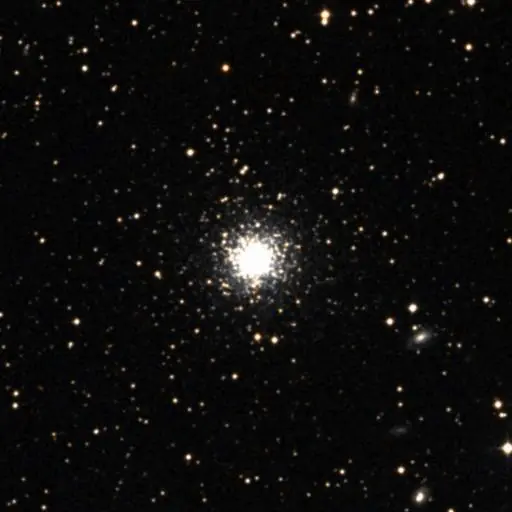
A far-flung star cluster in the galaxy’s halo — used as a signpost to Earth by the creator of Tarzan.
Wrapped around the Milky Way’s flat, spinning disc is the halo: a vast, roughly spherical region of dark matter, thin gas and scattered ancient star clusters. NGC 7006 lives far out in that halo, a globular cluster some five times farther from us than the centre of the galaxy.
From a planet orbiting one of its stars, the Milky Way would not be a band of light across the sky but a whole galaxy, seen from outside. The cluster has even found its way into fiction. Edgar Rice Burroughs, creator of Tarzan, used NGC 7006 as a signpost in his science-fiction story “Beyond the Farthest Star”: the people of the planet Poloda use it to work out roughly where Earth lies.
William Herschel discovered the cluster in 1784.
NGC 7006 (C 42) is 130,000 light-years away: the light we see from it set off about 130,000 years ago, when our species still lived mostly in Africa.
Did you know?
- Among the Dolphin’s stars. Delphinus, the Dolphin, is a small constellation with a big myth: in Greek legend a dolphin was set among the stars for rescuing the poet Arion — or, in another telling, for finding Poseidon his bride.
- Residents of the halo. The galactic halo is mostly dark matter, with thin gas and a sprinkling of ancient star clusters. NGC 7006 is one of its outlying residents, far beyond the busy disc where the Sun lives.
How big is it?
About 130,000 Suns’ worth of stars in a ball 159 light-years wide. Light itself takes 159 years to cross it. That’s 37 times the distance from the Sun to the nearest star. In its core the stars are packed so tightly that each one’s nearest neighbour is about 4 light-months away. Our nearest neighbour, Proxima Centauri, is 4.2 light-years from the Sun — 13 times farther. To break free from its centre, a star would need 16 km/s — 1.4 times the speed a rocket needs to leave Earth. It will hold together for another 17 billion years or so — longer than the universe has existed. Shrink our Solar System — the Sun and all eight planets — to the size of a coin, and NGC 7006 would be 4.01 km across (a 50-minute walk); the nearest star would be a football pitch away, and the Milky Way 2,520 km across.
A remote globular cluster in Delphinus, about 135,000 light-years away, that looks like a small, faint fuzzy star.
When and where to see it
It is best placed in the evening sky around September, when it crosses the meridian at about 10 pm local time (around midnight in August). It can be seen from everywhere north of 74°S and never sets north of 74°N.
At its highest it stands 56° up from 50°N, 71° up from 35°N, 74° up from the equator, 39° up from 35°S.
Facts
- Type
- Globular cluster
- Constellation
- Delphinus
- Designations
- C 42
- Magnitude
- 10.6
- Apparent size
- 4.2′
- Position
- RA 21h 1.5m, Dec +16° 11′ (J2000)
- Distance
- 130,000 light-years
- Discovered
- William Herschel, 1784
Open AstroPilot to see when NGC 7006 (C 42) is highest tonight from your location, how easy it is with your telescope or binoculars, and an eyepiece view.