NGC 6934 (C 47)
NGC 6934 (C 47) is a globular cluster in the constellation Delphinus, magnitude 8.8, 5.4′ across.
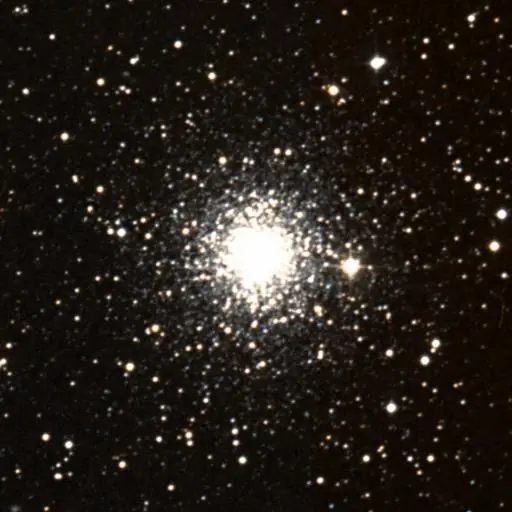
An ancient star cluster on a wild, plunging orbit through the Milky Way — and full of pulsing stars.
Most of the Milky Way’s stars circle its centre in a flat, orderly disc. NGC 6934 does not. This globular cluster follows a stretched, highly eccentric orbit tipped at 73° to the galaxy’s plane, swooping in towards the centre and then far back out again.
It may share a common origin with another globular cluster, NGC 5466. Inside, astronomers have counted 85 variable stars, 79 of them RR Lyrae stars — old pulsating stars that brighten and fade in less than a day, and whose rhythm makes them handy distance markers.
William Herschel found the cluster on 24 September 1785. Even so, as late as 2018 it was described as poorly studied — one of the sky’s ancient star cities still waiting for its close-up.
NGC 6934 (C 47) is 51,000 light-years away: the light we see from it set off about 51,000 years ago, when people were painting the oldest known cave art.
Did you know?
- More than one generation?. Its stars show a split subgiant branch, a sign that the cluster may contain more than one population of stars rather than a single generation born all at once.
- A trailing tail. There is some evidence that NGC 6934 is shedding stars into a tidal tail, stripped away by the Milky Way’s gravity as it swings through the galaxy.
How big is it?
About 150,000 Suns’ worth of stars in a ball 80 light-years wide. Light itself takes 80 years to cross it. That’s 19 times the distance from the Sun to the nearest star. In its core the stars are packed so tightly that each one’s nearest neighbour is about 54 light-days away. Our nearest neighbour, Proxima Centauri, is 4.2 light-years from the Sun — 29 times farther. To break free from its centre, a star would need 21 km/s — twice the speed a rocket needs to leave Earth. It will hold together for another 29 billion years or so — longer than the universe has existed. Shrink our Solar System — the Sun and all eight planets — to the size of a coin, and NGC 6934 would be 2.02 km across (a 25-minute walk); the nearest star would be a football pitch away, and the Milky Way 2,520 km across.
A small globular cluster in Delphinus, about 50,000 light-years away, showing a round glow in small telescopes.
When and where to see it
It is best placed in the evening sky around August, when it crosses the meridian at about 10 pm local time (around midnight in July). It can be seen from everywhere north of 83°S and never sets north of 83°N.
At its highest it stands 47° up from 50°N, 62° up from 35°N, 83° up from the equator, 48° up from 35°S.
Facts
- Type
- Globular cluster
- Constellation
- Delphinus
- Designations
- C 47
- Magnitude
- 8.8
- Apparent size
- 5.4′
- Position
- RA 20h 34.2m, Dec +7° 24′ (J2000)
- Distance
- 51,000 light-years
- Discovered
- William Herschel, 1785
Open AstroPilot to see when NGC 6934 (C 47) is highest tonight from your location, how easy it is with your telescope or binoculars, and an eyepiece view.