Great Peacock Globular (NGC 6752)
Great Peacock Globular (NGC 6752) is a globular cluster in the constellation Pavo, magnitude 5.4, 20′ across.
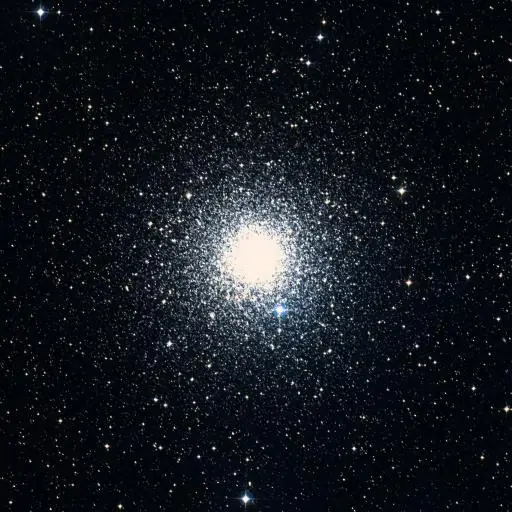
The fourth-brightest globular cluster in the sky, found by a Scot in Australia one winter night in 1826.
Only three globular clusters outshine it: Omega Centauri, 47 Tucanae and M 22. NGC 6752 — the Great Peacock Globular — is an ancient ball of stars about 11.8 billion years old, and its centre is packed so tightly that astronomers think its core has collapsed.
In a crowd that dense, stars meet. Many of its members are binaries, and it holds blue stragglers — stars that look too young and too blue for their age, probably made when smaller stars collided and merged. The Chandra X-ray Observatory has picked out six X-ray sources in its crowded core.
James Dunlop found it from Parramatta on 30 June 1826, describing a bright nebula that could be resolved into a cluster of many stars, highly compressed at the centre.
Great Peacock Globular (NGC 6752) is 13,000 light-years away: the light we see from it set off about 13,000 years ago, when the last Ice Age was ending.
Did you know?
- Named for a peacock. Its nickname comes from Pavo, the Peacock. The constellation’s brightest star is itself called Peacock — a name given in the late 1930s for the Royal Air Force’s navigation almanac.
- A double identity. The cluster may also carry a second catalogue number, NGC 6777 — an old entry that probably describes the same object, though nobody can be quite sure.
How big is it?
About 260,000 Suns’ worth of stars in a ball 77 light-years wide. Light itself takes 77 years to cross it. That’s 18 times the distance from the Sun to the nearest star. In its core the stars are packed so tightly that each one’s nearest neighbour is about 19 light-days away. Our nearest neighbour, Proxima Centauri, is 4.2 light-years from the Sun — 80 times farther. To break free from its centre, a star would need 31 km/s — 2.8 times the speed a rocket needs to leave Earth. It will hold together for another 27 billion years or so — longer than the universe has existed. Shrink our Solar System — the Sun and all eight planets — to the size of a coin, and Great Peacock Globular would be 1.95 km across (a 25-minute walk); the nearest star would be a football pitch away, and the Milky Way 2,520 km across.
A large, bright globular cluster in Pavo, about 13,000 light-years away and one of the finest in the southern sky, resolving well in small telescopes.
When and where to see it
It is best placed in the evening sky around August, when it crosses the meridian at about 10 pm local time (around midnight in July). It can be seen from everywhere south of 30°N and never sets south of 30°S.
At its highest it stands below the horizon from 50°N, below the horizon from 35°N, 30° up from the equator, 65° up from 35°S.
Facts
- Type
- Globular cluster
- Constellation
- Pavo
- Designations
- NGC 6752, NGC 6777, C 93
- Magnitude
- 5.4
- Apparent size
- 20′
- Position
- RA 19h 10.9m, Dec −59° 59′ (J2000)
- Distance
- 13,000 light-years
- Discovered
- James Dunlop, 1826
Open AstroPilot to see when Great Peacock Globular (NGC 6752) is highest tonight from your location, how easy it is with your telescope or binoculars, and an eyepiece view.