NGC 6638
NGC 6638 is a globular cluster in the constellation Sagittarius, magnitude 9.0, 4.2′ across.
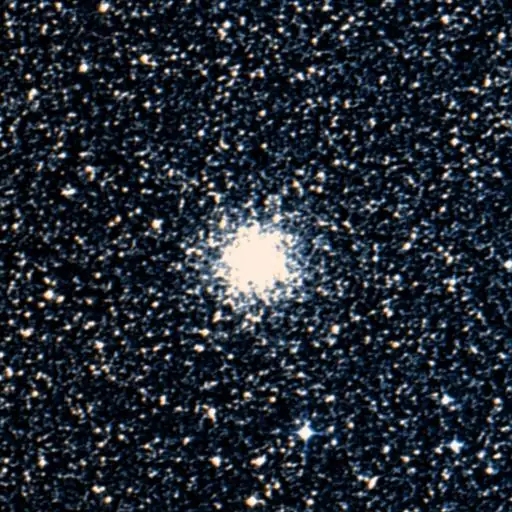
A compact globular cluster tucked beside the top of the Sagittarius Teapot’s lid.
Beside Kaus Borealis, the star that marks the top of the Teapot’s lid in Sagittarius, sits a globular cluster few people notice. NGC 6638 is a compact ball of ancient stars, one of the roughly 150 globular clusters that swarm around the centre of the Milky Way. William Herschel came across it in 1784, sweeping the sky with his 18.7-inch reflector.
NGC 6638 is 32,000 light-years away: the light we see from it set off about 32,000 years ago, when people were painting the oldest known cave art.
How big is it?
About 120,000 Suns’ worth of stars in a ball 39 light-years wide. Light itself takes 39 years to cross it. That’s 9.2 times the distance from the Sun to the nearest star. In its core the stars are packed so tightly that each one’s nearest neighbour is about 36 light-days away. Our nearest neighbour, Proxima Centauri, is 4.2 light-years from the Sun — 43 times farther. To break free from its centre, a star would need 27 km/s — 2.4 times the speed a rocket needs to leave Earth. The Milky Way’s tides will pull it apart in about 1.1 billion years. Shrink our Solar System — the Sun and all eight planets — to the size of a coin, and NGC 6638 would be 987 m across (9 football pitches end to end); the nearest star would be a football pitch away, and the Milky Way 2,520 km across.
A 9.0-magnitude globular cluster in Sagittarius, about 4.2′ across. It lies about 31,000 light-years away.
When and where to see it
It is best placed in the evening sky around July, when it crosses the meridian at about 10 pm local time (around midnight in June). It can be seen from everywhere south of 65°N and never sets south of 65°S.
At its highest it stands 15° up from 50°N, 30° up from 35°N, 65° up from the equator, 80° up from 35°S.
Facts
- Type
- Globular cluster
- Constellation
- Sagittarius
- Designations
- NGC 6638
- Magnitude
- 9.0
- Apparent size
- 4.2′
- Position
- RA 18h 30.9m, Dec −25° 30′ (J2000)
- Distance
- 32,000 light-years
- Discovered
- William Herschel, 1784
Open AstroPilot to see when NGC 6638 is highest tonight from your location, how easy it is with your telescope or binoculars, and an eyepiece view.