NGC 6544
NGC 6544 is a globular cluster in the constellation Sagittarius, magnitude 7.8, 6.0′ across.
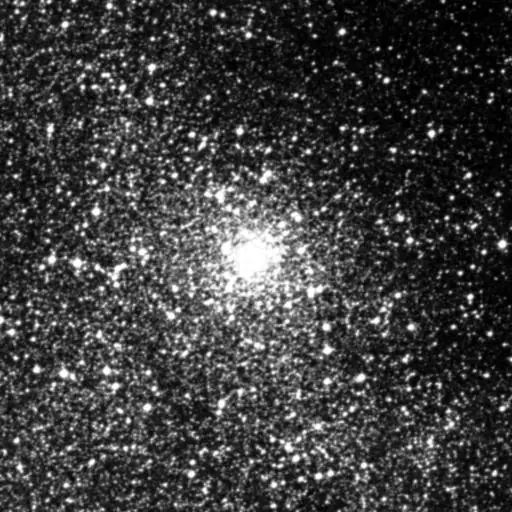
A tiny globular cluster beside the Lagoon Nebula, perhaps travelling with a newly found companion.
Just south-east of the Lagoon Nebula lies one of the smaller globular clusters known, and one of the closest to the plane of the Milky Way. William Herschel found NGC 6544 in 1784.
Its orbit is a puzzle. It circles the galaxy in the same direction as most stars, but on an unusual path and moving fast across our sky, and nobody is sure whether it was born here or captured. In 2021 a faint cluster, VVV CL160, was found with a similar position, chemistry and motion — perhaps a travelling companion.
NGC 6544 is 8,400 light-years away: the light we see from it set off around 6380 BC, 870 years before the first towns were growing in the Fertile Crescent.
Did you know?
- A pulsar with a partner. In 1999 a millisecond pulsar, PSR J1807−2459, was discovered in the cluster, locked in orbit with a companion star.
How big is it?
About 82,000 Suns’ worth of stars in a ball 15 light-years wide. Light itself takes 15 years to cross it. That’s 3.5 times the distance from the Sun to the nearest star. In its core the stars are packed so tightly that each one’s nearest neighbour is about 15 light-days away. Our nearest neighbour, Proxima Centauri, is 4.2 light-years from the Sun — 105 times farther. To break free from its centre, a star would need 25 km/s — 2.3 times the speed a rocket needs to leave Earth. The Milky Way’s tides will pull it apart in about 1.9 billion years. Shrink our Solar System — the Sun and all eight planets — to the size of a coin, and NGC 6544 would be 370 m across (4 football pitches end to end); the nearest star would be a football pitch away, and the Milky Way 2,520 km across.
A 7.8-magnitude globular cluster in Sagittarius, about 6′ across. It lies about 8,400 light-years away.
When and where to see it
It is best placed in the evening sky around July, when it crosses the meridian at about 10 pm local time (around midnight in June). It can be seen from everywhere south of 65°N and never sets south of 65°S.
At its highest it stands 15° up from 50°N, 30° up from 35°N, 65° up from the equator, 80° up from 35°S.
Facts
- Type
- Globular cluster
- Constellation
- Sagittarius
- Designations
- NGC 6544
- Magnitude
- 7.8
- Apparent size
- 6.0′
- Position
- RA 18h 7.3m, Dec −24° 60′ (J2000)
- Distance
- 8,400 light-years
- Discovered
- William Herschel, 1784
Open AstroPilot to see when NGC 6544 is highest tonight from your location, how easy it is with your telescope or binoculars, and an eyepiece view.