NGC 6541 (C 78)
NGC 6541 (C 78) is a globular cluster in the constellation Corona Australis, magnitude 6.3, 15′ across.
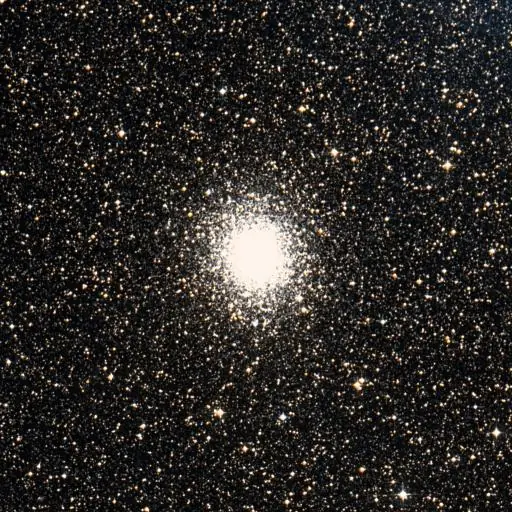
A star city nearly 13 billion years old, found by a Sicilian astronomer who hid his own name among the stars.
On 19 March 1826, at the Palermo Observatory in Sicily, Niccolò Cacciatore spotted a round glow in the southern constellation of Corona Australis. Three and a half months later, on the other side of the world, James Dunlop found it again independently from Australia.
The glow is a globular cluster holding more than half a million times the Sun’s mass, around 12.9 billion years old. It orbits deep in the crowded inner regions of the Milky Way, and its core is thought to have collapsed into a tight, dense knot. It is also one of the most metal-poor clusters near the galaxy’s centre: its stars contain very little besides hydrogen and helium.
Among its residents are 94 blue stragglers — stars that look too young for their age, probably rejuvenated by stealing mass from a companion or by merging with it.
NGC 6541 (C 78) is 25,000 light-years away: the light we see from it set off about 25,000 years ago, when the last Ice Age was at its height, and mammoths roamed beneath the ice sheets.
Did you know?
- A name written backwards. Cacciatore smuggled his name into the sky. Two stars in Delphinus are called Sualocin and Rotanev — read them backwards and you get Nicolaus Venator, the Latin form of Niccolò Cacciatore.
- Piazzi’s assistant. Cacciatore worked at Palermo under Giuseppe Piazzi, who in 1801 discovered Ceres — the first asteroid, now counted as a dwarf planet.
- Stars that touch. The cluster also hosts three W Ursae Majoris stars — pairs so close that they touch, sharing one outer envelope — and nine rapidly pulsing SX Phoenicis stars.
How big is it?
About 260,000 Suns’ worth of stars in a ball 109 light-years wide. Light itself takes 109 years to cross it. That’s 26 times the distance from the Sun to the nearest star. In its core the stars are packed so tightly that each one’s nearest neighbour is about 7 light-days away. Our nearest neighbour, Proxima Centauri, is 4.2 light-years from the Sun — 235 times farther. To break free from its centre, a star would need 37 km/s — 3.3 times the speed a rocket needs to leave Earth. The Milky Way’s tides will pull it apart in about 13 billion years. Shrink our Solar System — the Sun and all eight planets — to the size of a coin, and NGC 6541 would be 2.75 km across (a 35-minute walk); the nearest star would be a football pitch away, and the Milky Way 2,520 km across.
A bright globular cluster in Corona Australis, about 24,000 light-years away, with a dense core.
When and where to see it
It is best placed in the evening sky around July, when it crosses the meridian at about 10 pm local time (around midnight in June). It can be seen from everywhere south of 46°N and never sets south of 46°S.
At its highest it stands below the horizon from 50°N, 11° up from 35°N, 46° up from the equator, 81° up from 35°S.
Facts
- Type
- Globular cluster
- Constellation
- Corona Australis
- Designations
- C 78
- Magnitude
- 6.3
- Apparent size
- 15′
- Position
- RA 18h 8.0m, Dec −43° 43′ (J2000)
- Distance
- 25,000 light-years
- Discovered
- Niccolò Cacciatore, 1826, Found independently by James Dunlop the same year
Open AstroPilot to see when NGC 6541 (C 78) is highest tonight from your location, how easy it is with your telescope or binoculars, and an eyepiece view.