NGC 6397 (C 86)
NGC 6397 (C 86) is a globular cluster in the constellation Ara, magnitude 5.7, 32′ across.
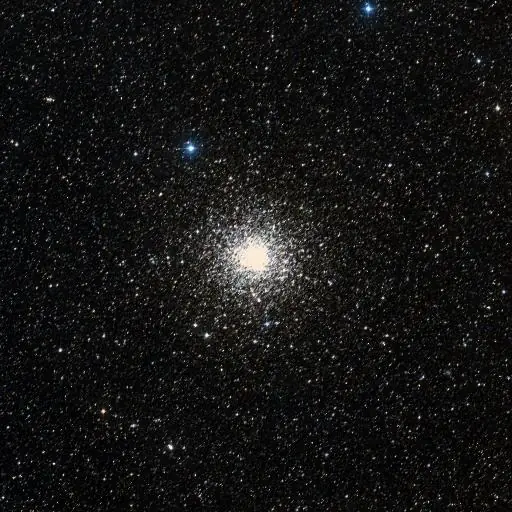
Ancient stars that helped date the Milky Way — and showed how small a star can be.
How old is the Milky Way? In 2004 astronomers turned to NGC 6397 for an answer. With the Very Large Telescope in Chile they measured beryllium in two of its stars — an element that slowly builds up in the galaxy, like sand in an hourglass. Adding the cluster’s own age gave an estimate for the whole galaxy: about 13.6 billion years, nearly as old as the universe itself.
Around 400,000 stars crowd into this globular cluster, and its core has collapsed into an extremely dense knot. In 2021 astronomers reported a hidden concentration of mass there, perhaps black holes. By 2022 the culprits looked more like hundreds of heavy white dwarfs, with essentially no black holes at all.
Nicolas-Louis de Lacaille discovered the cluster in 1752, from the Cape of Good Hope.
NGC 6397 (C 86) is 8,100 light-years away: the light we see from it set off around 6080 BC, 570 years before the first towns were growing in the Fertile Crescent.
Did you know?
- The smallest possible star. In 2006 Hubble found that the faintest stars in NGC 6397 suddenly run out. Below about 0.083 times the Sun’s mass, it seems, a ball of gas cannot ignite fusion in its core — and never becomes a true star.
- Clusters behind the cluster. Hubble’s deep pictures of NGC 6397 also caught many globular clusters belonging to galaxies far behind it — ancient star balls seen through another.
How big is it?
About 82,000 Suns’ worth of stars in a ball 75 light-years wide. Light itself takes 75 years to cross it. That’s 18 times the distance from the Sun to the nearest star. In its core the stars are packed so tightly that each one’s nearest neighbour is about 18 light-days away. Our nearest neighbour, Proxima Centauri, is 4.2 light-years from the Sun — 88 times farther. To break free from its centre, a star would need 22 km/s — twice the speed a rocket needs to leave Earth. The Milky Way’s tides will pull it apart in about 8.9 billion years. Shrink our Solar System — the Sun and all eight planets — to the size of a coin, and NGC 6397 would be 1.9 km across (a 25-minute walk); the nearest star would be a football pitch away, and the Milky Way 2,520 km across.
One of the two nearest globular clusters, about 7,500 light-years away; large and bright, it resolves easily in small telescopes.
When and where to see it
It is best placed in the evening sky around July, when it crosses the meridian at about 10 pm local time (around midnight in June). It can be seen from everywhere south of 36°N and never sets south of 36°S.
At its highest it stands below the horizon from 50°N, 1° up from 35°N, 36° up from the equator, 71° up from 35°S.
Facts
- Type
- Globular cluster
- Constellation
- Ara
- Designations
- C 86
- Magnitude
- 5.7
- Apparent size
- 32′
- Position
- RA 17h 40.7m, Dec −53° 40′ (J2000)
- Distance
- 8,100 light-years
- Discovered
- Nicolas-Louis de Lacaille, 1752
Open AstroPilot to see when NGC 6397 (C 86) is highest tonight from your location, how easy it is with your telescope or binoculars, and an eyepiece view.