NGC 6101 (C 107)
NGC 6101 (C 107) is a globular cluster in the constellation Apus, magnitude 9.2, 11′ across.
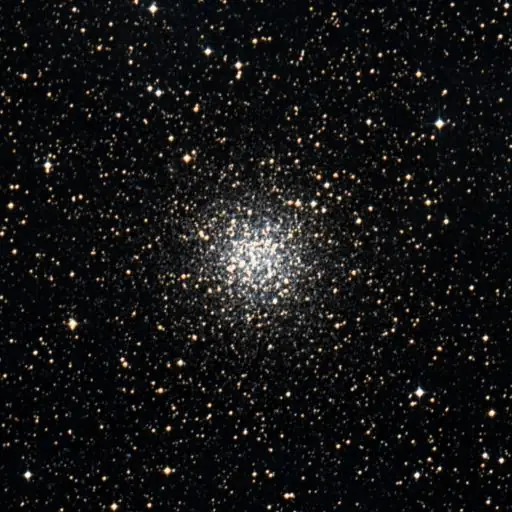
An ancient star ball in the Bird of Paradise that may be hiding a crowd of black holes.
Black holes are invisible, but they leave fingerprints. Astronomers studying NGC 6101 have concluded that this globular cluster holds an unexpectedly large number of them — the crushed remains of its most massive stars, still lurking among the survivors.
Those survivors are among the oldest stars in the Milky Way, packed together into a ball that circles the galaxy farther from its centre than the Sun does. They have been orbiting together since long before the Sun and Earth existed.
James Dunlop found the cluster in 1826 from Parramatta, near Sydney, and listed it as number 68 in his catalogue of southern nebulae and clusters. It sits in Apus, the Bird of Paradise — a constellation that has only been on star maps since around 1600, when Dutch navigators brought home the southern stars.
NGC 6101 (C 107) is 47,000 light-years away: the light we see from it set off about 47,000 years ago, when people were painting the oldest known cave art.
Did you know?
- A bird without feet. Apus means “footless”. The first bird-of-paradise skins to reach Europe had their feet removed, and people came to believe the birds never landed, spending their whole lives on the wing.
- Δ68. Dunlop’s catalogue of southern nebulae and clusters, published in 1828, listed more than 600 objects. Its entries are still written with a Greek delta for Dunlop, so this cluster is Δ68.
How big is it?
About 170,000 Suns’ worth of stars in a ball 146 light-years wide. Light itself takes 146 years to cross it. That’s 35 times the distance from the Sun to the nearest star. In its core the stars are packed so tightly that each one’s nearest neighbour is about 10 light-months away. Our nearest neighbour, Proxima Centauri, is 4.2 light-years from the Sun — 5.1 times farther. To break free from its centre, a star would need 12 km/s — about the speed a rocket needs to leave Earth. It will hold together for another 81 billion years or so — longer than the universe has existed. Shrink our Solar System — the Sun and all eight planets — to the size of a coin, and NGC 6101 would be 3.69 km across (a 45-minute walk); the nearest star would be a football pitch away, and the Milky Way 2,520 km across.
A faint, loose globular cluster in Apus, about 50,000 light-years away; larger telescopes begin to resolve it.
When and where to see it
It is best placed in the evening sky around June, when it crosses the meridian at about 10 pm local time (around midnight in May). It can be seen from everywhere south of 18°N and never sets south of 18°S.
At its highest it stands below the horizon from 50°N, below the horizon from 35°N, 18° up from the equator, 53° up from 35°S.
Facts
- Type
- Globular cluster
- Constellation
- Apus
- Designations
- C 107
- Magnitude
- 9.2
- Apparent size
- 11′
- Position
- RA 16h 25.8m, Dec −72° 12′ (J2000)
- Distance
- 47,000 light-years
- Discovered
- James Dunlop, 1826
Open AstroPilot to see when NGC 6101 (C 107) is highest tonight from your location, how easy it is with your telescope or binoculars, and an eyepiece view.