NGC 5927
NGC 5927 is a globular cluster in the constellation Lupus, magnitude 8.0, 6.6′ across.
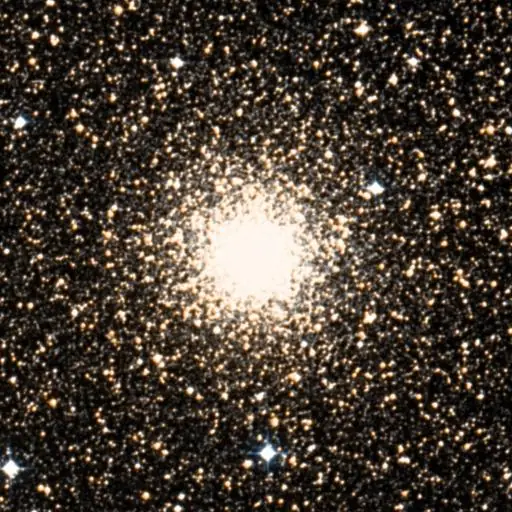
A globular cluster unusually rich in heavy elements, perhaps holding more than one generation of stars.
Most globular clusters are made of stars nearly empty of heavy elements, relics of the Milky Way’s youth. NGC 5927 is different: it is relatively metal-rich, and may hold more than one generation of stars. Metal-rich globulars like it tend to belong to the inner Galaxy, formed from gas already enriched by earlier stars. James Dunlop found it in 1826, and John Herschel observed it in 1834.
NGC 5927 is 27,000 light-years away: the light we see from it set off about 27,000 years ago, when the last Ice Age was at its height, and mammoths roamed beneath the ice sheets.
How big is it?
About 290,000 Suns’ worth of stars in a ball 52 light-years wide. Light itself takes 52 years to cross it. That’s 12 times the distance from the Sun to the nearest star. In its core the stars are packed so tightly that each one’s nearest neighbour is about 2 light-months away. Our nearest neighbour, Proxima Centauri, is 4.2 light-years from the Sun — 22 times farther. To break free from its centre, a star would need 25 km/s — 2.3 times the speed a rocket needs to leave Earth. It will hold together for another 34 billion years or so — longer than the universe has existed. Shrink our Solar System — the Sun and all eight planets — to the size of a coin, and NGC 5927 would be 1.31 km across (a 15-minute walk); the nearest star would be a football pitch away, and the Milky Way 2,520 km across.
An 8.0-magnitude globular cluster in Lupus, about 6.6′ across. It lies about 25,000 light-years away.
When and where to see it
It is best placed in the evening sky around June, when it crosses the meridian at about 10 pm local time (around midnight in May). It can be seen from everywhere south of 39°N and never sets south of 39°S.
At its highest it stands below the horizon from 50°N, 4° up from 35°N, 39° up from the equator, 74° up from 35°S.
Facts
- Type
- Globular cluster
- Constellation
- Lupus
- Designations
- NGC 5927
- Magnitude
- 8.0
- Apparent size
- 6.6′
- Position
- RA 15h 28.0m, Dec −50° 40′ (J2000)
- Distance
- 27,000 light-years
- Discovered
- James Dunlop, 1826
Open AstroPilot to see when NGC 5927 is highest tonight from your location, how easy it is with your telescope or binoculars, and an eyepiece view.