NGC 5466
NGC 5466 is a globular cluster in the constellation Boötes, magnitude 9.0, 6.6′ across.
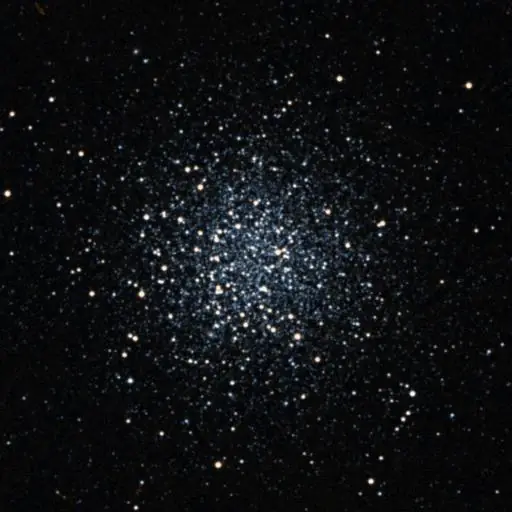
An ancient, loosely packed globular cluster shedding a stream of stars 45° or more long.
Over billions of years, the Milky Way’s tides have been pulling NGC 5466 apart. In 2006 astronomers found the evidence: a thin stream of stars torn from the cluster, stretching perhaps 45° to 60° across the sky. What remains is a loose globular cluster, unusually thinly packed for its brightness, with stars about 12 billion years old and very little of the heavy elements later generations would gain. William Herschel found it on 17 May 1784.
NGC 5466 is 53,000 light-years away: the light we see from it set off about 53,000 years ago, when people were painting the oldest known cave art.
Did you know?
- Blue stragglers. It holds 97 blue stragglers, stars that look younger than their neighbours. It was the first globular where an eclipsing blue straggler was found, and in 2019 another was found with a hot white dwarf companion.
- A record Cepheid. The cluster is home to V19, the brightest anomalous Cepheid known — a rare type of pulsating star.
How big is it?
About 56,000 Suns’ worth of stars in a ball 102 light-years wide. Light itself takes 102 years to cross it. That’s 24 times the distance from the Sun to the nearest star. In its core the stars are packed so tightly that each one’s nearest neighbour is about 16 light-months away. Our nearest neighbour, Proxima Centauri, is 4.2 light-years from the Sun — 3.3 times farther. To break free from its centre, a star would need 7 km/s — less than the 11.2 km/s a rocket needs to leave Earth. It will hold together for another 23 billion years or so — longer than the universe has existed. Shrink our Solar System — the Sun and all eight planets — to the size of a coin, and NGC 5466 would be 2.57 km across (a 30-minute walk); the nearest star would be a football pitch away, and the Milky Way 2,520 km across.
A 9.0-magnitude globular cluster in Boötes, about 6.6′ across. It lies about 52,000 light-years away.
When and where to see it
It is best placed in the evening sky around May, when it crosses the meridian at about 10 pm local time (around midnight in April). It can be seen from everywhere north of 61°S and never sets north of 61°N.
At its highest it stands 69° up from 50°N, 84° up from 35°N, 61° up from the equator, 26° up from 35°S.
Facts
- Type
- Globular cluster
- Constellation
- Boötes
- Designations
- NGC 5466
- Magnitude
- 9.0
- Apparent size
- 6.6′
- Position
- RA 14h 5.5m, Dec +28° 32′ (J2000)
- Distance
- 53,000 light-years
- Discovered
- William Herschel, 1784
Open AstroPilot to see when NGC 5466 is highest tonight from your location, how easy it is with your telescope or binoculars, and an eyepiece view.