Omega Centauri (NGC 5139)
Omega Centauri (NGC 5139) is a globular cluster in the constellation Centaurus, magnitude 3.7, 36′ across.
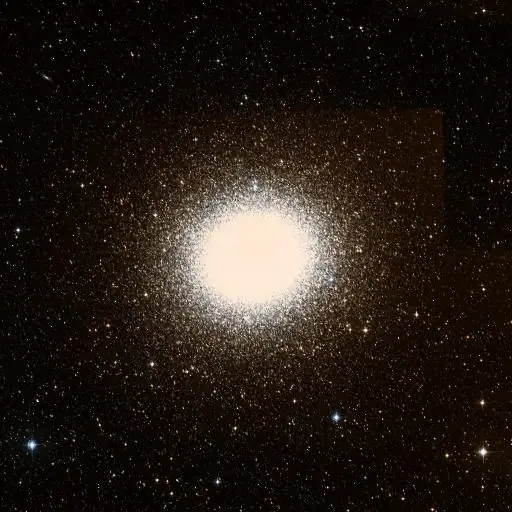
Ten million stars that Ptolemy took for one — perhaps the heart of a galaxy the Milky Way swallowed.
For most of history, Omega Centauri was a star. Around AD 150 Ptolemy listed it in his Almagest as a star on the centaur’s back, and in 1603 Johann Bayer gave it a star’s Greek letter. Then in 1677 Edmond Halley, observing with a telescope from the island of Saint Helena, saw that it was no star at all. In 1826 James Dunlop recognised it as a ‘beautiful globe of stars’.
That globe holds some 10 million stars, about 4 million Suns’ worth of mass: the heaviest globular cluster in the Milky Way. In the core, stars sit on average about forty times closer together than the Sun and its nearest neighbour. From a planet there, the night sky would be crowded with brilliant stars.
Unlike a typical globular, its stars span a range of ages and chemistry, which suggests that Omega Centauri is the leftover core of a small galaxy swallowed long ago. Kapteyn’s Star, one of the Sun’s near neighbours, is thought to have come from it.
Omega Centauri (NGC 5139) is 18,000 light-years away: the light we see from it set off about 18,000 years ago, when the last Ice Age was at its height, and mammoths roamed beneath the ice sheets.
Did you know?
- A black hole at the heart?. In 2008 astronomers reported signs of a black hole of 40,000 Suns at its centre. Later work disputed it; a 2024 study of seven fast-moving stars argued for one of at least 8,200 Suns, but that too has been questioned.
- Second only to Mayall II. Of all the globular clusters in the Local Group of galaxies, only Mayall II in the Andromeda Galaxy is brighter and more massive than Omega Centauri.
- In science fiction. Ian Douglas’s 2012 novel Singularity builds its plot on Omega Centauri being a dwarf galaxy’s remains, and the Perry Rhodan spin-off series Atlan sends its hero there.
How big is it?
About 3.9 million Suns’ worth of stars in a ball 190 light-years wide. Light itself takes 190 years to cross it. That’s 45 times the distance from the Sun to the nearest star. In its core the stars are packed so tightly that each one’s nearest neighbour is about 3 light-months away. Our nearest neighbour, Proxima Centauri, is 4.2 light-years from the Sun — 20 times farther. To break free from its centre, a star would need 62 km/s — 5.6 times the speed a rocket needs to leave Earth. It will hold together for another 129 billion years or so — longer than the universe has existed. Shrink our Solar System — the Sun and all eight planets — to the size of a coin, and Omega Centauri would be 4.8 km across (an hour’s walk); the nearest star would be a football pitch away, and the Milky Way 2,520 km across.
The largest and brightest globular cluster in the sky, with millions of stars; visible to the naked eye as a fuzzy star, it may be the core of a dwarf galaxy absorbed by the Milky Way.
When and where to see it
It is best placed in the evening sky around May, when it crosses the meridian at about 10 pm local time (around midnight in April). It can be seen from everywhere south of 43°N and never sets south of 43°S.
At its highest it stands below the horizon from 50°N, 8° up from 35°N, 43° up from the equator, 78° up from 35°S.
Facts
- Type
- Globular cluster
- Constellation
- Centaurus
- Designations
- NGC 5139, C 80
- Magnitude
- 3.7
- Apparent size
- 36′
- Position
- RA 13h 26.8m, Dec −47° 29′ (J2000)
- Distance
- 18,000 light-years
- Discovered
- Edmond Halley, 1677, Catalogued as a star by Ptolemy around AD 150; Halley first saw it was not a star
Open AstroPilot to see when Omega Centauri (NGC 5139) is highest tonight from your location, how easy it is with your telescope or binoculars, and an eyepiece view.