NGC 4833 (C 105)
NGC 4833 (C 105) is a globular cluster in the constellation Musca, magnitude 6.9, 14′ across.
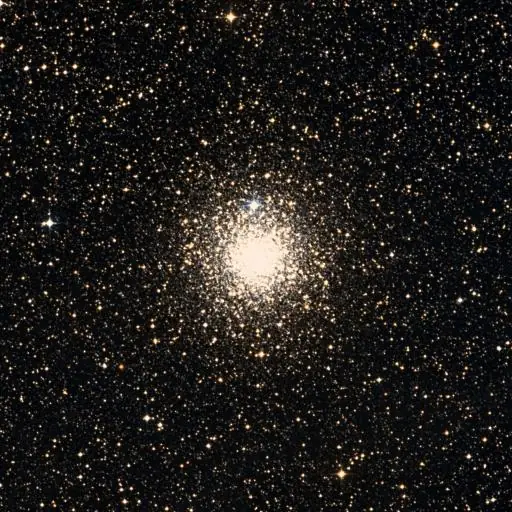
One of the galaxy’s elder clusters, on a plunging orbit that has probably cost it much of its mass.
Even among globular clusters, NGC 4833 is old. After correcting for the dust that reddens its light, astronomers found evidence that it is around two billion years older than the globulars M 5 and M 92. It is massive and poor in heavy elements, and its stars show signs of more than one generation, born at different times.
Nicolas-Louis de Lacaille found it during his 1751–52 stay in South Africa and catalogued it in 1755. It took the larger telescopes of James Dunlop and John Herschel to resolve it into individual stars.
NGC 4833 (C 105) is 21,000 light-years away: the light we see from it set off about 21,000 years ago, when the last Ice Age was at its height, and mammoths roamed beneath the ice sheets.
Did you know?
- A plunging orbit. Its orbit is so stretched that it carries the cluster close to the Galactic Centre. Repeated passes by the crowded central bulge have probably stripped away a large part of its original mass.
- A census of variables. A 2012 survey found 19 RR Lyrae stars, six SX Phoenicis stars and two eclipsing binaries in NGC 4833 — a cluster full of stars that pulse or wink.
How big is it?
About 190,000 Suns’ worth of stars in a ball 82 light-years wide. Light itself takes 82 years to cross it. That’s 19 times the distance from the Sun to the nearest star. In its core the stars are packed so tightly that each one’s nearest neighbour is about 2 light-months away. Our nearest neighbour, Proxima Centauri, is 4.2 light-years from the Sun — 20 times farther. To break free from its centre, a star would need 22 km/s — twice the speed a rocket needs to leave Earth. The Milky Way’s tides will pull it apart in about 6.4 billion years. Shrink our Solar System — the Sun and all eight planets — to the size of a coin, and NGC 4833 would be 2.08 km across (a 25-minute walk); the nearest star would be a football pitch away, and the Milky Way 2,520 km across.
A globular cluster in Musca, partly dimmed by dust, which gives it an irregular look.
When and where to see it
It is best placed in the evening sky around May, when it crosses the meridian at about 10 pm local time (around midnight in April). It can be seen from everywhere south of 19°N and never sets south of 19°S.
At its highest it stands below the horizon from 50°N, below the horizon from 35°N, 19° up from the equator, 54° up from 35°S.
Facts
- Type
- Globular cluster
- Constellation
- Musca
- Designations
- C 105
- Magnitude
- 6.9
- Apparent size
- 14′
- Position
- RA 12h 59.6m, Dec −70° 53′ (J2000)
- Distance
- 21,000 light-years
- Discovered
- Nicolas-Louis de Lacaille, 1751, Found in 1751–52; catalogued in 1755
Open AstroPilot to see when NGC 4833 (C 105) is highest tonight from your location, how easy it is with your telescope or binoculars, and an eyepiece view.