Mice Galaxy (NGC 4676)
Mice Galaxy (NGC 4676) is a galaxy group in the constellation Coma Berenices, 3.0′ across.
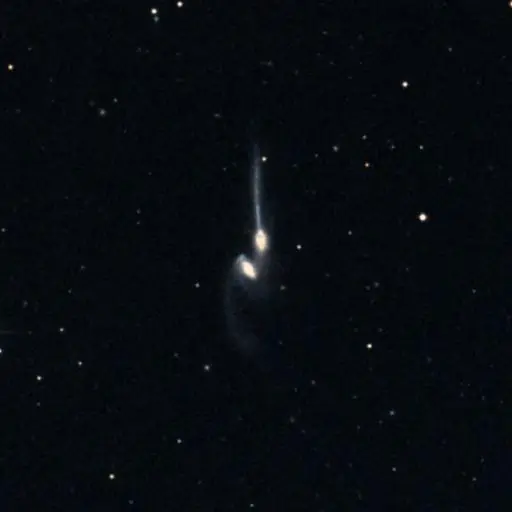
Two colliding galaxies trailing long tails of stars, like a pair of mice.
Two galaxies in the Coma Cluster are in the middle of a collision, and the pull of each on the other has drawn out long, thin tails of stars and gas. Those tails gave the pair its name: the Mice. They should keep colliding until they merge into one.
Their colours are odd too. One tail starts blue and ends yellowish — the reverse of the usual pattern in a spiral’s arms. William Herschel found the pair in 1785.
Mice Galaxy (NGC 4676) is 310 million light-years away: the light we see from it set off about 310 million years ago, when the first plants and animals were moving onto land.
Did you know?
- Hubble’s view. In 2002 the Hubble Space Telescope photographed the Mice in detail. The same picture shows more than 3,000 far more distant galaxies scattered across the background.
How big is it?
2.7 times as wide as our Milky Way. Light itself takes 270,000 years to cross it. Shrink it to the length of a football pitch and our whole Solar System would be smaller than a bacterium.
A pair of galaxies in Coma Berenices, about 3′ across.
When and where to see it
It is best placed in the evening sky around May, when it crosses the meridian at about 10 pm local time (around midnight in April). It can be seen from everywhere north of 59°S and never sets north of 59°N.
At its highest it stands 71° up from 50°N, 86° up from 35°N, 59° up from the equator, 24° up from 35°S.
Facts
- Type
- Galaxy group
- Constellation
- Coma Berenices
- Designations
- NGC 4676
- Apparent size
- 3.0′
- Position
- RA 12h 46.2m, Dec +30° 44′ (J2000)
- Distance
- 310 million light-years
- Discovered
- William Herschel, 1785
Open AstroPilot to see when Mice Galaxy (NGC 4676) is highest tonight from your location, how easy it is with your telescope or binoculars, and an eyepiece view.