Antennae Galaxies (NGC 4038)
Antennae Galaxies (NGC 4038) is a galaxy in the constellation Corvus, magnitude 10.2, 5.4′ × 3.8′ across.
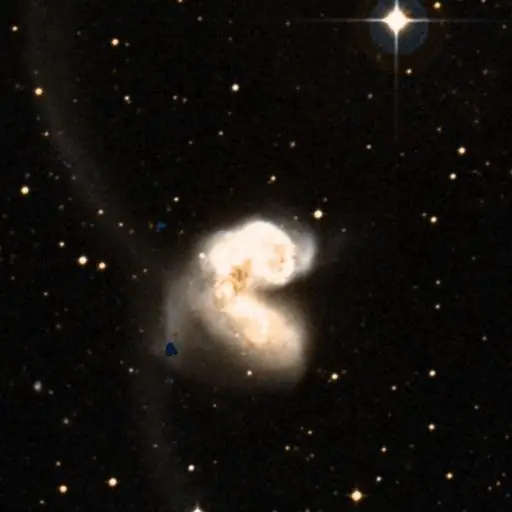
The northern half of a galactic pile-up — where the crash is forging brand-new star clusters.
Two galaxies are colliding in Corvus, and NGC 4038 is the northern half of the wreck. About 1.2 billion years ago it was a normal barred spiral galaxy. Then its neighbour NGC 4039 came close, and the two have been tearing at each other ever since.
The crash has set off a burst of star birth. As clouds of gas slam together, shock waves squeeze them into new stars — and even into new globular clusters. Most globulars in our own galaxy are around 12 billion years old; these are youngsters, born in the collision.
The pair has taught astronomers how galaxies merge. Alar Toomre’s famous sequence of colliding galaxies was built in part by successfully modelling the long, curving tails thrown out by NGC 4038 and its partner.
Antennae Galaxies (NGC 4038) is 72 million light-years away: the light we see from it set off about 72 million years ago, when dinosaurs still walked the Earth.
Did you know?
- Supernova after supernova. Four supernovae have been seen in NGC 4038, in 1974, 2004, 2007 and 2013. One of them, SN 2007sr, helped astronomers measure how far away the colliding pair is.
- Pulsing yardsticks. Around 53 Cepheid variables have been found in NGC 4038 — pulsing stars whose rhythm reveals their true brightness, and so their distance.
How big is it?
About as wide as our Milky Way. Light itself takes 110,000 years to cross it. Shrink it to the length of a football pitch and our whole Solar System would be smaller than a bacterium.
One half of the Antennae, two colliding spiral galaxies in Corvus; telescopes show a curved, comma-shaped glow beside NGC 4039, and photographs the long tidal tails.
When and where to see it
It is best placed in the evening sky around April, when it crosses the meridian at about 10 pm local time (around midnight in March). It can be seen from everywhere south of 71°N and never sets south of 71°S.
At its highest it stands 21° up from 50°N, 36° up from 35°N, 71° up from the equator, 74° up from 35°S.
Facts
- Type
- Galaxy
- Constellation
- Corvus
- Designations
- NGC 4038, C 60, Antennae Galaxies
- Magnitude
- 10.2
- Apparent size
- 5.4′ × 3.8′
- Position
- RA 12h 1.9m, Dec −18° 52′ (J2000)
- Distance
- 72 million light-years
- Discovered
- William Herschel, 1785
Open AstroPilot to see when Antennae Galaxies (NGC 4038) is highest tonight from your location, how easy it is with your telescope or binoculars, and an eyepiece view.