NGC 3626 (NGC 3632)
NGC 3626 (NGC 3632) is a galaxy in the constellation Leo, magnitude 11.0, 2.9′ × 1.9′ across.
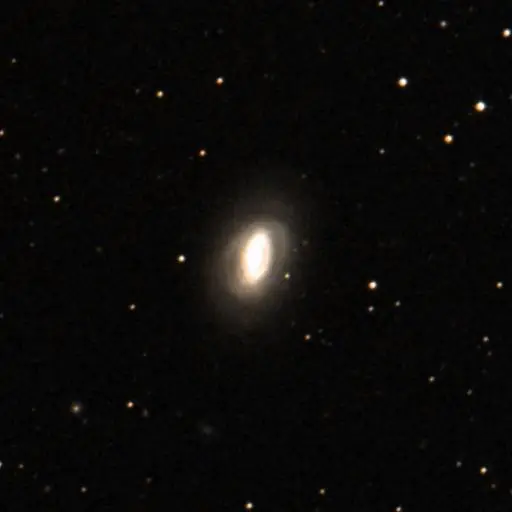
A spiral galaxy without its arms, logged twice by the catalogue-makers and living among a crowd in Leo.
Strip the arms from a spiral galaxy and what remains is a lens-shaped disc of stars around a bright central bulge, with no spiral pattern at all — a lenticular galaxy. NGC 3626 is one of them, an unbarred example in Leo.
William Herschel found it on 14 March 1784, during his great sweeps of the sky with his home-built telescopes.
It does not live alone. NGC 3626 belongs to the NGC 3607 group, one of many small galaxy groups scattered through Leo, and its neighbours in the sky include NGC 3607, NGC 3608 and a handful of other galaxies.
NGC 3626 (NGC 3632) is 65 million light-years away: the light we see from it set off about 65 million years ago, when mammals were taking over a world without dinosaurs.
Did you know?
- Two numbers, one galaxy. It carries two numbers in the New General Catalogue, NGC 3626 and NGC 3632 — the same galaxy logged twice, a common slip in the 19th-century catalogues.
- Caldwell 40. Patrick Moore included it as number 40 in his Caldwell catalogue of 1995, a list of 109 fine sights that Charles Messier’s catalogue left out.
How big is it?
56% of the Milky Way’s width. Light itself takes 56,000 years to cross it. Shrink it to the length of a football pitch and our whole Solar System would be smaller than a bacterium.
A lenticular galaxy in Leo, a small oval glow with a bright center.
When and where to see it
It is best placed in the evening sky around April, when it crosses the meridian at about 10 pm local time (around midnight in March). It can be seen from everywhere north of 72°S and never sets north of 72°N.
At its highest it stands 58° up from 50°N, 73° up from 35°N, 72° up from the equator, 37° up from 35°S.
Facts
- Type
- Galaxy
- Constellation
- Leo
- Designations
- NGC 3632, C 40
- Magnitude
- 11.0
- Apparent size
- 2.9′ × 1.9′
- Position
- RA 11h 20.1m, Dec +18° 21′ (J2000)
- Distance
- 65 million light-years
- Discovered
- William Herschel, 1784
Open AstroPilot to see when NGC 3626 (NGC 3632) is highest tonight from your location, how easy it is with your telescope or binoculars, and an eyepiece view.