NGC 362 (C 104)
NGC 362 (C 104) is a globular cluster in the constellation Tucana, magnitude 6.4, 14′ across.
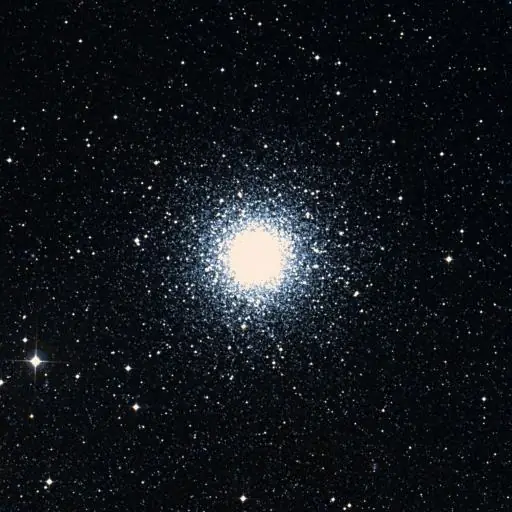
A youthful globular cluster on a looping orbit that plunges close to the heart of the Milky Way.
James Dunlop discovered NGC 362 on 1 August 1826, during his survey of the southern sky. It is a globular cluster, one of the ancient balls of stars that orbit our galaxy — yet an unusual one. Its stars contain more heavy elements than the stars of most globulars, which suggests that it formed relatively late for its kind.
It lives a dramatic life. Its orbit is highly elongated, carrying it in close to the centre of the Milky Way and then far back out again. It has an exceptionally tight core, and an unusually large share of its stars are binaries, pairs locked in orbit around each other.
NGC 362 (C 104) is 29,000 light-years away: the light we see from it set off about 29,000 years ago, when the last Ice Age was at its height, and mammoths roamed beneath the ice sheets.
Did you know?
- Close to the centre. At the inner end of its stretched orbit, NGC 362 dives deep into the Milky Way, much closer to the galactic centre than the Sun ever comes.
- In a famous shadow. NGC 362 is visible to the naked eye under dark skies, but it is often overlooked in favour of its larger and brighter neighbour on the sky, 47 Tucanae.
How big is it?
About 250,000 Suns’ worth of stars in a ball 118 light-years wide. Light itself takes 118 years to cross it. That’s 28 times the distance from the Sun to the nearest star. In its core the stars are packed so tightly that each one’s nearest neighbour is about 28 light-days away. Our nearest neighbour, Proxima Centauri, is 4.2 light-years from the Sun — 55 times farther. To break free from its centre, a star would need 34 km/s — 3 times the speed a rocket needs to leave Earth. The Milky Way’s tides will pull it apart in about 7.5 billion years. Shrink our Solar System — the Sun and all eight planets — to the size of a coin, and NGC 362 would be 2.98 km across (a 35-minute walk); the nearest star would be a football pitch away, and the Milky Way 2,520 km across.
A bright globular cluster beside the Small Magellanic Cloud, though it lies far in the foreground, in our own galaxy, about 28,000 light-years away.
When and where to see it
It is best placed in the evening sky around November, when it crosses the meridian at about 10 pm local time (around midnight in October). It can be seen from everywhere south of 19°N and never sets south of 19°S.
At its highest it stands below the horizon from 50°N, below the horizon from 35°N, 19° up from the equator, 54° up from 35°S.
Facts
- Type
- Globular cluster
- Constellation
- Tucana
- Designations
- C 104, Mel 4, Melotte 4
- Magnitude
- 6.4
- Apparent size
- 14′
- Position
- RA 1h 3.2m, Dec −70° 51′ (J2000)
- Distance
- 29,000 light-years
- Discovered
- James Dunlop, 1826
Open AstroPilot to see when NGC 362 (C 104) is highest tonight from your location, how easy it is with your telescope or binoculars, and an eyepiece view.