NGC 3585
NGC 3585 is a galaxy in the constellation Hydra, magnitude 9.7, 6.6′ × 3.3′ across.
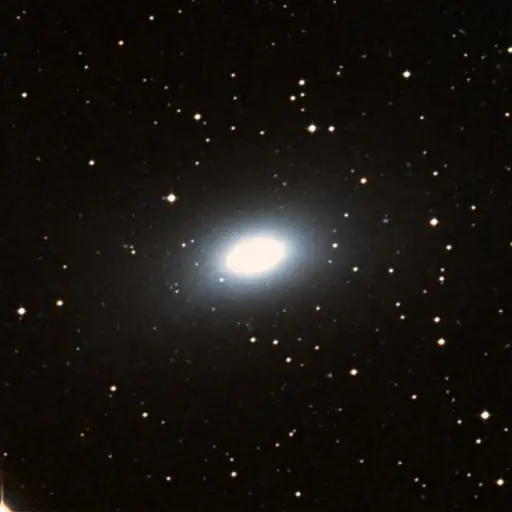
A massive galaxy with a black hole of hundreds of millions of suns at its core.
At the heart of NGC 3585 sits a black hole weighing a few hundred million suns. The galaxy around it is big and smooth, classed as either elliptical or lenticular, and it leads a loose galaxy group & cluster of its own in Hydra. A reddish disc of dust lies in its core, and its outer light is lopsided — perhaps the mark of a past tidal encounter. William Herschel found it on 9 December 1784.
NGC 3585 is 65 million light-years away: the light we see from it set off about 65 million years ago, when mammals were taking over a world without dinosaurs.
Did you know?
- A late batch of clusters. NGC 3585 has about 550 globular clusters, a modest number typical of lone ellipticals. Their brightnesses hint that some of them are younger than the rest.
How big is it?
1.2 times as wide as our Milky Way. Light itself takes 120,000 years to cross it. Shrink it to the length of a football pitch and our whole Solar System would be smaller than a bacterium.
A 9.7-magnitude elliptical galaxy (E) in Hydra, about 6.6′ × 3.3′.
When and where to see it
It is best placed in the evening sky around April, when it crosses the meridian at about 10 pm local time (around midnight in March). It can be seen from everywhere south of 63°N and never sets south of 63°S.
At its highest it stands 13° up from 50°N, 28° up from 35°N, 63° up from the equator, 82° up from 35°S.
Facts
- Type
- Galaxy
- Constellation
- Hydra
- Designations
- NGC 3585
- Magnitude
- 9.7
- Apparent size
- 6.6′ × 3.3′
- Position
- RA 11h 13.3m, Dec −26° 45′ (J2000)
- Distance
- 65 million light-years
- Discovered
- William Herschel, 1784
Open AstroPilot to see when NGC 3585 is highest tonight from your location, how easy it is with your telescope or binoculars, and an eyepiece view.