NGC 3201 (C 79)
NGC 3201 (C 79) is a globular cluster in the constellation Vela, magnitude 6.8, 20′ across.
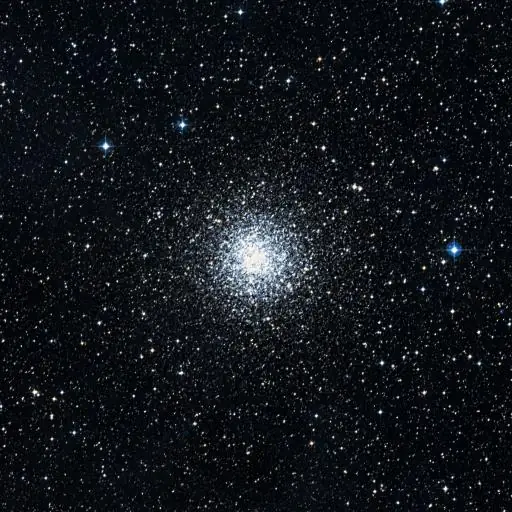
A ten-billion-year-old cluster racing away at record speed — with a hidden swarm of black holes.
Every second, NGC 3201 moves about 490 kilometres farther away from us. No other known globular cluster has a higher speed along our line of sight. Even so, it is not fast enough to escape the Milky Way.
Its stars are about ten billion years old, more than twice the age of the Sun, and together they hold around 157,000 Suns’ worth of mass.
Because its stars are thinly packed and the cluster is far from collapsing in on itself, astronomers think its core harbours many black holes. A few have already been caught orbiting ordinary stars. A 2022 study using Hubble and Gaia found that the core may hide a sub-cluster of nearly a hundred stellar black holes, together weighing about a thousand Suns.
NGC 3201 (C 79) is 15,000 light-years away: the light we see from it set off about 15,000 years ago, when the last Ice Age was at its height, and mammoths roamed beneath the ice sheets.
Did you know?
- Dunlop’s find. James Dunlop discovered NGC 3201 on 28 May 1826 and listed it in his 1827 catalogue, noting that it was ‘easily resolved into stars’.
- Stars sorted by colour. Its stars are not uniform: the redder, cooler ones gather towards the core. As of 2010 only one other globular, M 4, was known to show such a clear variation.
How big is it?
About 190,000 Suns’ worth of stars in a ball 87 light-years wide. Light itself takes 87 years to cross it. That’s 21 times the distance from the Sun to the nearest star. In its core the stars are packed so tightly that each one’s nearest neighbour is about 4 light-months away. Our nearest neighbour, Proxima Centauri, is 4.2 light-years from the Sun — 14 times farther. To break free from its centre, a star would need 17 km/s — 1.5 times the speed a rocket needs to leave Earth. It will hold together for another 69 billion years or so — longer than the universe has existed. Shrink our Solar System — the Sun and all eight planets — to the size of a coin, and NGC 3201 would be 2.2 km across (a 25-minute walk); the nearest star would be a football pitch away, and the Milky Way 2,520 km across.
A large, loose globular cluster in Vela, easily resolved; it orbits the Milky Way in the opposite direction to most of the galaxy's stars.
When and where to see it
It is best placed in the evening sky around March, when it crosses the meridian at about 10 pm local time (around midnight in February). It can be seen from everywhere south of 44°N and never sets south of 44°S.
At its highest it stands below the horizon from 50°N, 9° up from 35°N, 44° up from the equator, 79° up from 35°S.
Facts
- Type
- Globular cluster
- Constellation
- Vela
- Designations
- C 79
- Magnitude
- 6.8
- Apparent size
- 20′
- Position
- RA 10h 17.6m, Dec −46° 25′ (J2000)
- Distance
- 15,000 light-years
- Discovered
- James Dunlop, 1826
Open AstroPilot to see when NGC 3201 (C 79) is highest tonight from your location, how easy it is with your telescope or binoculars, and an eyepiece view.