NGC 2775 (C 48)
NGC 2775 (C 48) is a galaxy in the constellation Cancer, magnitude 10.2, 4.3′ × 3.4′ across.
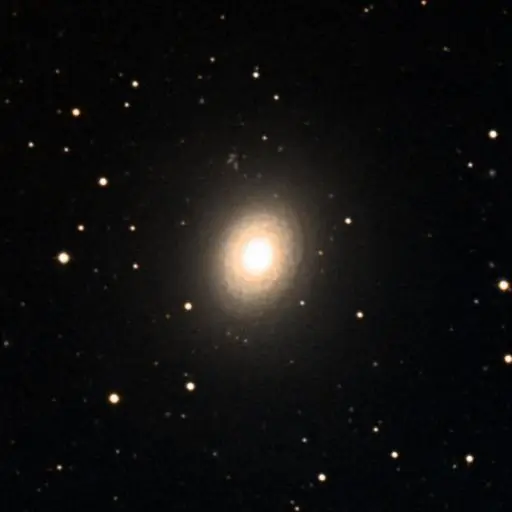
A galaxy with a quiet heart, a ring of newborn stars, and the scars of a smaller galaxy it has been shredding.
The heart of NGC 2775 is a quiet place. Its central bulge holds almost no gas, and virtually no new stars are forming there; one idea is that a high rate of supernovae long ago swept the gas away. Even its nucleus is inactive.
The action is further out, in a dusty ring where stars are still being born — though at a gentle pace, with no burst of star formation.
This spiral galaxy also carries the scars of a past meal. A small satellite galaxy seems to have looped around it several times, shedding stars at each pass and leaving faint, shell-like ripples. A neighbouring irregular galaxy, NGC 2777, trails a tail of hydrogen gas that points back towards NGC 2775, as if the two have touched.
NGC 2775 (C 48) is 55 million light-years away: the light we see from it set off about 55 million years ago, when mammals were taking over a world without dinosaurs.
Did you know?
- A supernova caught late. SN 1993Z, a Type Ia supernova — the explosion of a white dwarf — was found here on 23 September 1993. Two days later its spectrum showed it had already peaked about four weeks earlier.
- Head of the family. NGC 2775 is the leading member of a small galaxy group & cluster named after it, the NGC 2775 Group, which also includes NGC 2777 and UGC 4781.
How big is it?
68% of the Milky Way’s width. Light itself takes 68,000 years to cross it. Shrink it to the length of a football pitch and our whole Solar System would be smaller than a bacterium.
A spiral in Cancer with a large, smooth central bulge and tightly wound arms, appearing as an oval glow.
When and where to see it
It is best placed in the evening sky around March, when it crosses the meridian at about 10 pm local time (around midnight in February). It can be seen from everywhere north of 83°S and never sets north of 83°N.
At its highest it stands 47° up from 50°N, 62° up from 35°N, 83° up from the equator, 48° up from 35°S.
Facts
- Type
- Galaxy
- Constellation
- Cancer
- Designations
- C 48
- Magnitude
- 10.2
- Apparent size
- 4.3′ × 3.4′
- Position
- RA 9h 10.3m, Dec +7° 2′ (J2000)
- Distance
- 55 million light-years
- Discovered
- William Herschel, 1783
Open AstroPilot to see when NGC 2775 (C 48) is highest tonight from your location, how easy it is with your telescope or binoculars, and an eyepiece view.