NGC 2655
NGC 2655 is a galaxy in the constellation Camelopardalis, magnitude 10.4, 3.9′ × 2.1′ across.
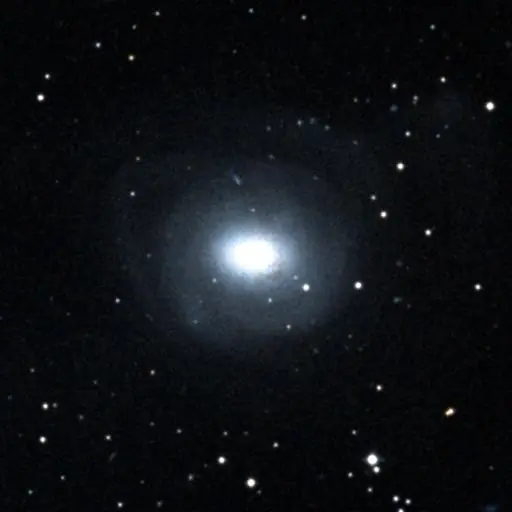
A galaxy scarred by mergers, leading a small group near the north celestial pole.
NGC 2655 wears the scars of a busy past. A lenticular galaxy — a disc with no real spiral arms — it is crossed by lopsided dust lanes and trails long arms of stars and hydrogen gas, signs of at least one recent merger and probably more before that. At its centre is an active Seyfert nucleus. It is the brightest member of a small galaxy group & cluster close to the north celestial pole, and William Herschel found it on 26 September 1802.
NGC 2655 is 68 million light-years away: the light we see from it set off about 68 million years ago, when dinosaurs still walked the Earth.
Did you know?
- A white dwarf blows up. In January 2011 Kōichi Itagaki and Masaki Tsuboi discovered a supernova here, SN 2011B. It was a Type Ia — the thermonuclear explosion of a white dwarf.
How big is it?
78% of the Milky Way’s width. Light itself takes 78,000 years to cross it. Shrink it to the length of a football pitch and our whole Solar System would be smaller than a bacterium.
A 10.4-magnitude lenticular galaxy (S0-a) in Camelopardalis, about 3.9′ × 2.1′.
When and where to see it
It is best placed in the evening sky around March, when it crosses the meridian at about 10 pm local time (around midnight in January). It can be seen from everywhere north of 12°S and never sets north of 12°N.
At its highest it stands 62° up from 50°N, 47° up from 35°N, 12° up from the equator, below the horizon from 35°S.
Facts
- Type
- Galaxy
- Constellation
- Camelopardalis
- Designations
- NGC 2655
- Magnitude
- 10.4
- Apparent size
- 3.9′ × 2.1′
- Position
- RA 8h 55.6m, Dec +78° 13′ (J2000)
- Distance
- 68 million light-years
- Discovered
- William Herschel, 1802
Open AstroPilot to see when NGC 2655 is highest tonight from your location, how easy it is with your telescope or binoculars, and an eyepiece view.