NGC 2477 (C 71)
NGC 2477 (C 71) is an open cluster in the constellation Puppis, magnitude 5.8, 19′ across.
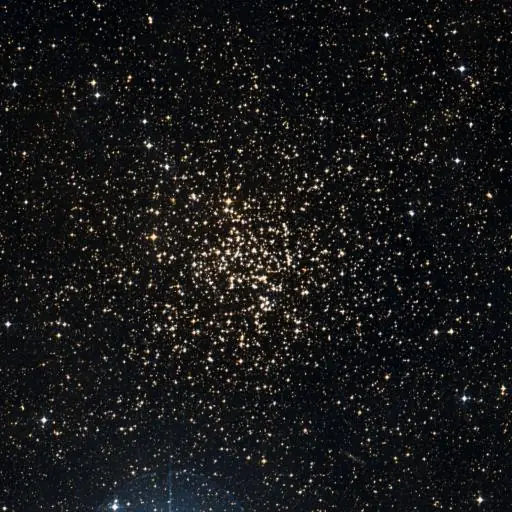
Three hundred stars that have stayed together for a billion years, in the stern of Jason’s ship.
Picture a globular cluster with its dense core scooped out and you have the idea of NGC 2477. About 300 stars crowd this open cluster, so many that some observers rank it among the finest open clusters in the sky. It also answers to a curious nickname, the Termite Hole Cluster.
Nicolas-Louis de Lacaille found it in 1751, during the stay at the Cape of Good Hope in which he charted the southern sky. Robert Burnham Jr. later noted that several observers had remarked on its richness: smaller than its neighbour M 46, but richer and more compact.
NGC 2477 (C 71) is 4,500 light-years away: the light we see from it set off around 2480 BC, around the time the Great Pyramid of Giza was completed.
Did you know?
- In the stern of the Argo. The cluster lies in Puppis, the stern of the old constellation Argo Navis — the ship of Jason and the Argonauts. Lacaille himself split the ship into three, creating Puppis, Vela and Carina.
- A billion years together. Its stars have stayed together for about a billion years. That is a long life for an open cluster; most are pulled apart by the Milky Way’s tides far sooner.
How big is it?
Born about 1.1 billion years ago, when there were no animals on Earth at all. Light itself takes 24 years to cross it. Gaia has picked out 3,543 stars moving together through space as its members. That’s 5.7 times the distance from the Sun to the nearest star. Shrink our Solar System — the Sun and all eight planets — to the size of a coin, and NGC 2477 would be 614 m across (6 football pitches end to end); the nearest star would be a football pitch away, and the Milky Way 2,520 km across.
A rich, compact open cluster in Puppis with hundreds of faint stars, a fine sight in any telescope.
When and where to see it
It is best placed in the evening sky around February, when it crosses the meridian at about 10 pm local time (around midnight in January). It can be seen from everywhere south of 51°N and never sets south of 51°S.
At its highest it stands 1° up from 50°N, 16° up from 35°N, 51° up from the equator, 86° up from 35°S.
Facts
- Type
- Open cluster
- Constellation
- Puppis
- Designations
- C 71, Mel 78, Cr 165, Melotte 78, Collinder 165
- Magnitude
- 5.8
- Apparent size
- 19′
- Position
- RA 7h 52.2m, Dec −38° 32′ (J2000)
- Distance
- 4,500 light-years
- Discovered
- Nicolas-Louis de Lacaille, 1751
Open AstroPilot to see when NGC 2477 (C 71) is highest tonight from your location, how easy it is with your telescope or binoculars, and an eyepiece view.