NGC 2419 (C 25)
NGC 2419 (C 25) is a globular cluster in the constellation Lynx, magnitude 10.4, 4.5′ across.
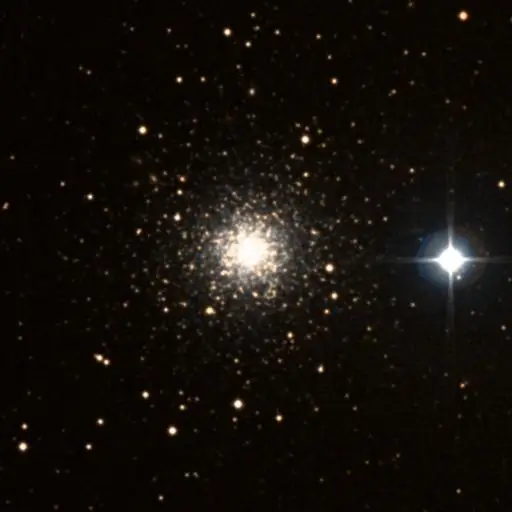
A lonely globular on a three-billion-year orbit — the cluster astronomers in Andromeda would spot first.
Imagine you are an astronomer in the Andromeda Galaxy, scanning the Milky Way for its globular clusters. Leoš Ondra pointed out that NGC 2419 would be your best and brightest catch: it orbits far outside our galaxy’s dusty disc, with nothing in the way.
That lonely path earned it the nickname the Intergalactic Wanderer, back when astronomers thought it might not belong to the Milky Way at all. It does, just — but one lap around the galaxy takes it about three billion years.
Out there it is a heavyweight, one of the brightest and most massive globulars our galaxy owns, at around 900,000 times the Sun’s mass. Its stars come in two families, one richer in helium than the other — something current ideas of how such clusters form struggle to explain.
NGC 2419 (C 25) is 290,000 light-years away: the light we see from it set off about 290,000 years ago, when the first Homo sapiens appeared in Africa.
Did you know?
- A New Year’s Eve find. William Herschel discovered NGC 2419 on 31 December 1788 — New Year’s Eve at the telescope.
- Heavier than it looks. The cluster weighs more than its light suggests. A central black hole could explain it — but so could a crowd of smaller black holes, faint stars sunk to the middle, or dark matter.
- A swallowed galaxy?. Some astronomers proposed that, like Omega Centauri, it is the leftover core of a small galaxy torn apart by the Milky Way. Others dispute the idea.
How big is it?
About 780,000 Suns’ worth of stars in a ball 380 light-years wide. Light itself takes 380 years to cross it. That’s 90 times the distance from the Sun to the nearest star. In its core the stars are packed so tightly that each one’s nearest neighbour is about 9 light-months away. Our nearest neighbour, Proxima Centauri, is 4.2 light-years from the Sun — 5.4 times farther. To break free from its centre, a star would need 18 km/s — 1.6 times the speed a rocket needs to leave Earth. It will hold together for another 1,560 billion years or so — longer than the universe has existed. Shrink our Solar System — the Sun and all eight planets — to the size of a coin, and NGC 2419 would be 9.58 km across (a 2-hour walk); the nearest star would be a football pitch away, and the Milky Way 2,520 km across.
One of the most remote globular clusters of the Milky Way, about 270,000 light-years away — farther than the Magellanic Clouds — hence its nickname, the Intergalactic Wanderer. It appears as a small, faint glow.
When and where to see it
It is best placed in the evening sky around February, when it crosses the meridian at about 10 pm local time (around midnight in January). It can be seen from everywhere north of 51°S and never sets north of 51°N.
At its highest it stands 79° up from 50°N, 86° up from 35°N, 51° up from the equator, 16° up from 35°S.
Facts
- Type
- Globular cluster
- Constellation
- Lynx
- Designations
- C 25
- Magnitude
- 10.4
- Apparent size
- 4.5′
- Position
- RA 7h 38.1m, Dec +38° 53′ (J2000)
- Distance
- 290,000 light-years
- Discovered
- William Herschel, 1788
Open AstroPilot to see when NGC 2419 (C 25) is highest tonight from your location, how easy it is with your telescope or binoculars, and an eyepiece view.