NGC 2383
NGC 2383 is an open cluster in the constellation Canis Major, magnitude 8.4, 4.2′ across.
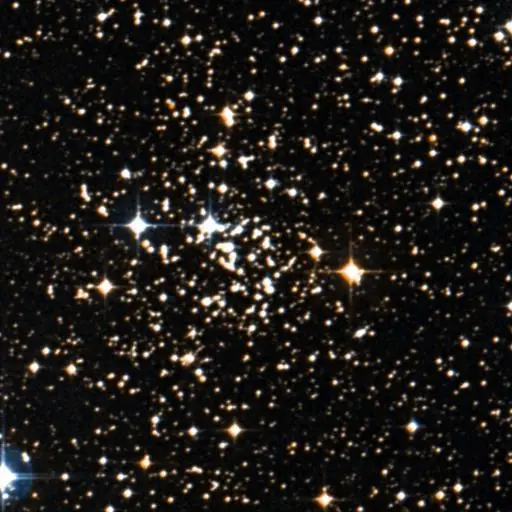
One of a close pair of clusters in Canis Major — neighbours in the sky, and in the catalogue too.
NGC 2383 and NGC 2384 appear almost touching in the sky, and their numbers sit side by side too. That is no accident: the New General Catalogue lists its objects in order of right ascension, the sky’s east–west coordinate, so neighbouring objects often get consecutive numbers. Whether the two open clusters are also neighbours in space is another matter, since clusters that line up in the sky can lie at very different distances.
NGC 2383 is 10,000 light-years away: the light we see from it set off around 7980 BC, 1,530 years after the stone pillars of Göbekli Tepe, the oldest known temple, were raised.
How big is it?
Born about 260 million years ago, when the first plants and animals were moving onto land. Light itself takes 12 years to cross it. Gaia has picked out 391 stars moving together through space as its members. That’s 2.9 times the distance from the Sun to the nearest star. Shrink our Solar System — the Sun and all eight planets — to the size of a coin, and NGC 2383 would be 308 m across (3 football pitches end to end); the nearest star would be a football pitch away, and the Milky Way 2,520 km across.
An 8.4-magnitude open cluster in Canis Major, about 4.2′ across.
When and where to see it
It is best placed in the evening sky around February, when it crosses the meridian at about 10 pm local time (around midnight in January). It can be seen from everywhere south of 69°N and never sets south of 69°S.
At its highest it stands 19° up from 50°N, 34° up from 35°N, 69° up from the equator, 76° up from 35°S.
Facts
- Type
- Open cluster
- Constellation
- Canis Major
- Designations
- NGC 2383
- Magnitude
- 8.4
- Apparent size
- 4.2′
- Position
- RA 7h 24.7m, Dec −20° 57′ (J2000)
- Distance
- 10,000 light-years
Open AstroPilot to see when NGC 2383 is highest tonight from your location, how easy it is with your telescope or binoculars, and an eyepiece view.