Rosette Nebula (NGC 2237)
Rosette Nebula (NGC 2237) is an emission nebula in the constellation Monoceros, magnitude 6.0 (blue), 1.3° × 1.0° across.
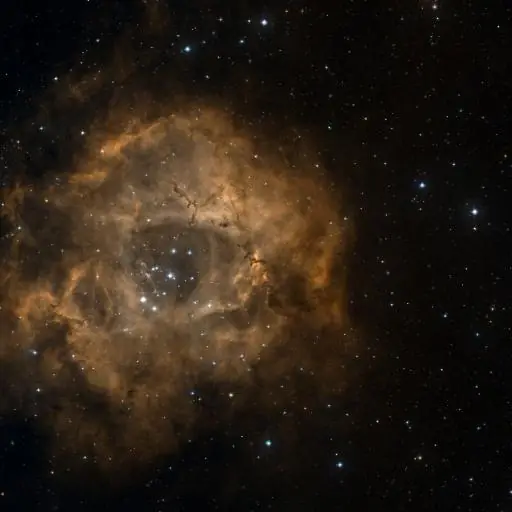
A cosmic rose — or a skull, to some — hollowed out by the hot young stars born inside it.
In long-exposure photographs it blooms like a red rose, though some see a human skull and call it the Skull Nebula. The Rosette is a huge emission nebula, a cloud holding around 10,000 Suns’ worth of gas, glowing because the young stars of the cluster NGC 2244 light it from inside.
Those stars were born from the nebula itself, and now they are hollowing it out. A handful of hot O-type stars, led by HD 46223 and HD 46150, drive winds that have blown a bubble in the middle. X-ray telescopes found that bubble filled with gas at one to ten million degrees — far hotter than the 10,000 degrees typical of such clouds.
The flower is still putting out buds. About 2,500 young stars crowd the complex, and most new star birth is under way in the dark Rosette Molecular Cloud just to the south-east.
Rosette Nebula (NGC 2237) is 5,200 light-years away: the light we see from it set off around 3180 BC, around the time writing was invented in Mesopotamia.
Did you know?
- A state symbol. In April 2019 Oklahoma made the Rosette its official state astronomical object. The legislature passed the bill on 16 April and Governor Kevin Stitt signed it into law six days later.
- One flower, many numbers. The nebula was catalogued piece by piece, so its petals carry several NGC numbers — 2237, 2238 and 2246 among them — while the cluster at its heart is NGC 2244.
How big is it?
29 times the distance from the Sun to the nearest star. Light itself takes 121 years to cross it. Shrink our Solar System — the Sun and all eight planets — to the size of a coin, and the Rosette Nebula would be 3.05 km across (a 35-minute walk); the nearest star would be a football pitch away, and the Milky Way 2,520 km across.
A huge ring of glowing gas around the young cluster NGC 2244 in Monoceros. Binoculars show the cluster; a UHC or OIII filter at low power reveals the nebula's petals.
When and where to see it
It is best placed in the evening sky around January, when it crosses the meridian at about 10 pm local time (around midnight in December). It can be seen from everywhere north of 85°S and never sets north of 85°N.
At its highest it stands 45° up from 50°N, 60° up from 35°N, 85° up from the equator, 50° up from 35°S.
Facts
- Type
- Emission nebula
- Constellation
- Monoceros
- Designations
- NGC 2237, NGC 2238, NGC 2246, C 49, Rosette A, Rosette B
- Magnitude
- 6.0 (blue)
- Apparent size
- 1.3° × 1.0°
- Position
- RA 6h 30.7m, Dec +5° 1′ (J2000)
- Distance
- 5,200 light-years
- Discovered
- Catalogued in pieces during the 1800s; its central cluster was seen by John Flamsteed in 1690
Open AstroPilot to see when Rosette Nebula (NGC 2237) is highest tonight from your location, how easy it is with your telescope or binoculars, and an eyepiece view.