NGC 2158
NGC 2158 is an open cluster in the constellation Gemini, magnitude 8.6, 8.4′ across.
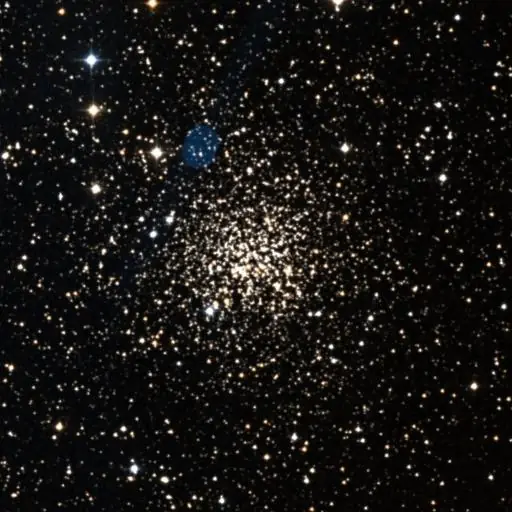
M 35’s faint companion in the sky — far more distant, far older, and crammed with some 3,000 stars.
Right beside the bright cluster M 35, NGC 2158 looks like a smaller sibling. It is nothing of the kind: it lies far beyond M 35, and at about 2 billion years old it is many times older. Some 3,000 stars are packed into it, so many that astronomers once took it for a globular cluster. Today it is counted as a rich open cluster that is poor in heavy elements — an in-between object. William Herschel found it in 1784.
NGC 2158 is 12,000 light-years away: the light we see from it set off about 12,000 years ago, when the last Ice Age was ending.
Did you know?
- A rare kind of variable. Among its stars is a cataclysmic variable — a white dwarf pulling gas from a close companion — only the fourth known in any open cluster.
How big is it?
Born about 1.5 billion years ago, when there were no animals on Earth at all. Light itself takes 29 years to cross it. Gaia has picked out 1,958 stars moving together through space as its members. That’s 6.9 times the distance from the Sun to the nearest star. Shrink our Solar System — the Sun and all eight planets — to the size of a coin, and NGC 2158 would be 740 m across (7 football pitches end to end); the nearest star would be a football pitch away, and the Milky Way 2,520 km across.
An 8.6-magnitude open cluster in Gemini, about 8.4′ across.
When and where to see it
It is best placed in the evening sky around January, when it crosses the meridian at about 10 pm local time (around midnight in December). It can be seen from everywhere north of 66°S and never sets north of 66°N.
At its highest it stands 64° up from 50°N, 79° up from 35°N, 66° up from the equator, 31° up from 35°S.
Facts
- Type
- Open cluster
- Constellation
- Gemini
- Designations
- NGC 2158
- Magnitude
- 8.6
- Apparent size
- 8.4′
- Position
- RA 6h 7.4m, Dec +24° 6′ (J2000)
- Distance
- 12,000 light-years
- Discovered
- William Herschel, 1784
Open AstroPilot to see when NGC 2158 is highest tonight from your location, how easy it is with your telescope or binoculars, and an eyepiece view.