NGC 2100
NGC 2100 is a globular cluster in the constellation Dorado, magnitude 9.6 (blue), 2.5′ × 2.5′ across.
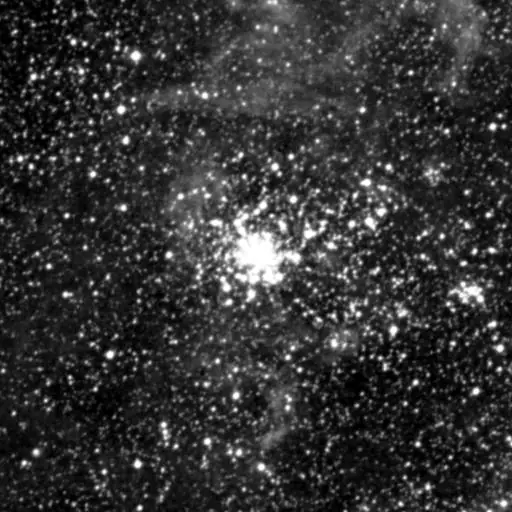
A round, rich young cluster in the Large Magellanic Cloud that is easily mistaken for a globular.
Round and densely packed, NGC 2100 looks at first glance like an ancient globular cluster. It is in fact a young open cluster in the Large Magellanic Cloud — the kind that lasts for tens or hundreds of millions of years before gravitational tugs from other bodies scatter its stars. James Dunlop added it to his southern catalogue in 1826.
NGC 2100 is 160,000 light-years away: the light we see from it set off about 160,000 years ago, when our species still lived mostly in Africa.
How big is it?
27 times the distance from the Sun to the nearest star. Light itself takes 116 years to cross it. Shrink our Solar System — the Sun and all eight planets — to the size of a coin, and NGC 2100 would be 2.94 km across (a 35-minute walk); the nearest star would be a football pitch away, and the Milky Way 2,520 km across.
A 9.6-magnitude (B-band) globular cluster in Dorado, about 2.5′ across.
When and where to see it
It is best placed in the evening sky around January, when it crosses the meridian at about 10 pm local time (around midnight in December). It can be seen from everywhere south of 21°N and never sets south of 21°S.
At its highest it stands below the horizon from 50°N, below the horizon from 35°N, 21° up from the equator, 56° up from 35°S.
Facts
- Type
- Globular cluster
- Constellation
- Dorado
- Designations
- NGC 2100
- Magnitude
- 9.6 (blue)
- Apparent size
- 2.5′ × 2.5′
- Position
- RA 5h 42.1m, Dec −69° 13′ (J2000)
- Distance
- 160,000 light-years
- Discovered
- James Dunlop, 1826
Open AstroPilot to see when NGC 2100 is highest tonight from your location, how easy it is with your telescope or binoculars, and an eyepiece view.