NGC 1856
NGC 1856 is a globular cluster in the constellation Dorado, magnitude 10.1, 2.7′ × 2.4′ across.
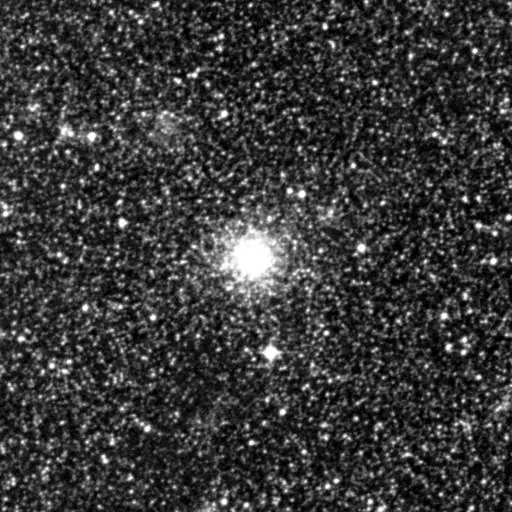
A ‘blue globular’ in the Large Magellanic Cloud — massive, but young.
NGC 1856 has the mass of a globular cluster but not the age. It is a young, massive cluster in the Large Magellanic Cloud, the kind sometimes called a “blue globular”, because its hot, young stars are still shining. Its age has been revised: first estimated at about 80 million years, later at around 300 million. James Dunlop discovered it in 1826 with a 9-inch reflecting telescope.
NGC 1856 is 160,000 light-years away: the light we see from it set off about 160,000 years ago, when our species still lived mostly in Africa.
How big is it?
30 times the distance from the Sun to the nearest star. Light itself takes 126 years to cross it. Shrink our Solar System — the Sun and all eight planets — to the size of a coin, and NGC 1856 would be 3.17 km across (a 40-minute walk); the nearest star would be a football pitch away, and the Milky Way 2,520 km across.
A 10.1-magnitude globular cluster in Dorado, about 2.7′ × 2.4′.
When and where to see it
It is best placed in the evening sky around January, when it crosses the meridian at about 10 pm local time (around midnight in December). It can be seen from everywhere south of 21°N and never sets south of 21°S.
At its highest it stands below the horizon from 50°N, below the horizon from 35°N, 21° up from the equator, 56° up from 35°S.
Facts
- Type
- Globular cluster
- Constellation
- Dorado
- Designations
- NGC 1856
- Magnitude
- 10.1
- Apparent size
- 2.7′ × 2.4′
- Position
- RA 5h 9.5m, Dec −69° 8′ (J2000)
- Distance
- 160,000 light-years
- Discovered
- James Dunlop, 1826
Open AstroPilot to see when NGC 1856 is highest tonight from your location, how easy it is with your telescope or binoculars, and an eyepiece view.