NGC 1850
NGC 1850 is a globular cluster in the constellation Dorado, magnitude 9.0, 3.0′ × 3.0′ across.
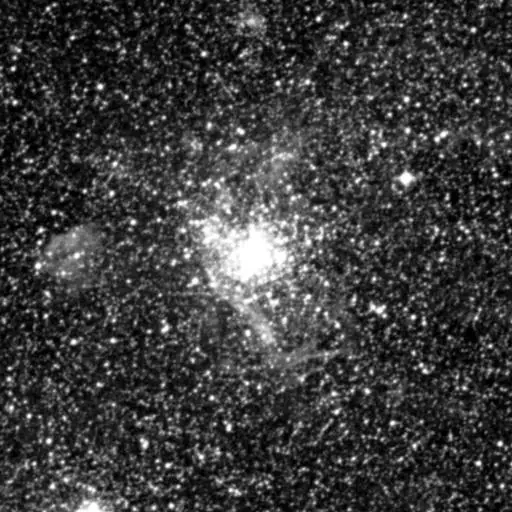
A young ‘globular’ in the Large Magellanic Cloud, with a still younger cluster at its side.
NGC 1850 looks like a globular cluster, but its stars are young: the main cluster is around 50 to 100 million years old and holds some 42,000 times the mass of the Sun. Beside it sits a smaller, looser cluster, NGC 1850A, only about 4 million years old, with stars of 35 to more than 50 solar masses. In the Milky Way, only Westerlund 1 is anything like it.
The pair lies in the bar of the Large Magellanic Cloud. James Dunlop discovered it in 1826.
NGC 1850 is 160,000 light-years away: the light we see from it set off about 160,000 years ago, when our species still lived mostly in Africa.
Did you know?
- A hidden black hole?. In November 2021 astronomers using the Very Large Telescope reported a black hole in NGC 1850, spotted through its pull on a nearby star — claimed as the first found this way in a young, massive cluster.
How big is it?
About 42,000 Suns’ worth of stars in a ball 140 light-years wide. Light itself takes 140 years to cross it. That’s 33 times the distance from the Sun to the nearest star. Shrink our Solar System — the Sun and all eight planets — to the size of a coin, and NGC 1850 would be 3.52 km across (a 40-minute walk); the nearest star would be a football pitch away, and the Milky Way 2,520 km across.
A 9.0-magnitude globular cluster in Dorado, about 3′ across.
When and where to see it
It is best placed in the evening sky around January, when it crosses the meridian at about 10 pm local time (around midnight in December). It can be seen from everywhere south of 21°N and never sets south of 21°S.
At its highest it stands below the horizon from 50°N, below the horizon from 35°N, 21° up from the equator, 56° up from 35°S.
Facts
- Type
- Globular cluster
- Constellation
- Dorado
- Designations
- NGC 1850
- Magnitude
- 9.0
- Apparent size
- 3.0′ × 3.0′
- Position
- RA 5h 8.7m, Dec −68° 46′ (J2000)
- Distance
- 160,000 light-years
- Discovered
- James Dunlop, 1826
Open AstroPilot to see when NGC 1850 is highest tonight from your location, how easy it is with your telescope or binoculars, and an eyepiece view.