NGC 1399
NGC 1399 is a galaxy in the constellation Fornax, magnitude 9.4, 8.5′ × 7.7′ across.
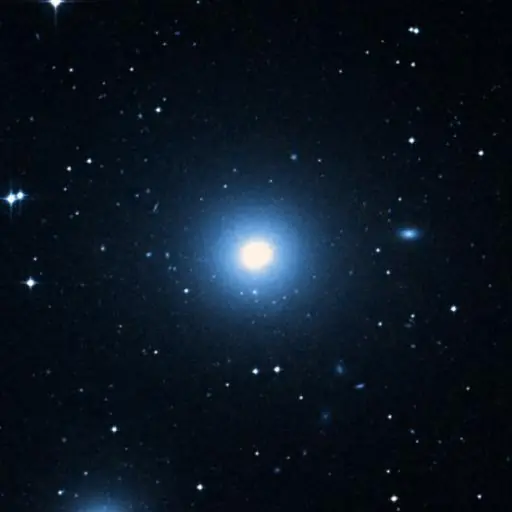
The giant at the heart of the Fornax Cluster, ringed by thousands of globular clusters.
At the centre of the Fornax Cluster sits NGC 1399, a giant elliptical galaxy wrapped in a vast, faint envelope of stars. Its gravity has made it a collector. Somewhere between 5,700 and 6,500 globular clusters swarm around it, and many may have been taken from its neighbours: NGC 1404 seems to have given up most of its own, and NGC 1387 may have lost some too.
John Herschel discovered it on 22 October 1835.
NGC 1399 is 65 million light-years away: the light we see from it set off about 65 million years ago, when mammals were taking over a world without dinosaurs.
Did you know?
- Out of fuel. When the Herschel Space Observatory, named after William Herschel, surveyed giant elliptical galaxies, most turned out to hold plenty of cold gas, the raw material of stars. NGC 1399 was one of only two exceptions.
- Stars in circles. Near its central black hole of about 510 million Suns, stars move mostly in circles around the centre rather than in and out — more strongly than in any other galaxy measured at the time.
How big is it?
1.6 times as wide as our Milky Way. Light itself takes 160,000 years to cross it. Shrink it to the length of a football pitch and our whole Solar System would be smaller than a bacterium.
A 9.4-magnitude elliptical galaxy (E) in Fornax, about 8.5′ × 7.7′.
When and where to see it
It is best placed in the evening sky around December, when it crosses the meridian at about 10 pm local time (around midnight in November). It can be seen from everywhere south of 55°N and never sets south of 55°S.
At its highest it stands 5° up from 50°N, 20° up from 35°N, 55° up from the equator, 90° up from 35°S.
Facts
- Type
- Galaxy
- Constellation
- Fornax
- Designations
- NGC 1399
- Magnitude
- 9.4
- Apparent size
- 8.5′ × 7.7′
- Position
- RA 3h 38.5m, Dec −35° 27′ (J2000)
- Distance
- 65 million light-years
- Discovered
- John Herschel, 1835
Open AstroPilot to see when NGC 1399 is highest tonight from your location, how easy it is with your telescope or binoculars, and an eyepiece view.